Blog · AI Agent News · AI video VIEN
Apple Releases FastFrames: 35.4 ms AI Video on One GPU
Apple open-sourced FastFrames (14B & 1.3B), cutting 480p AI video latency to 35.4 ms on one GPU. Here are the benchmarks and hardware limits.
In this article
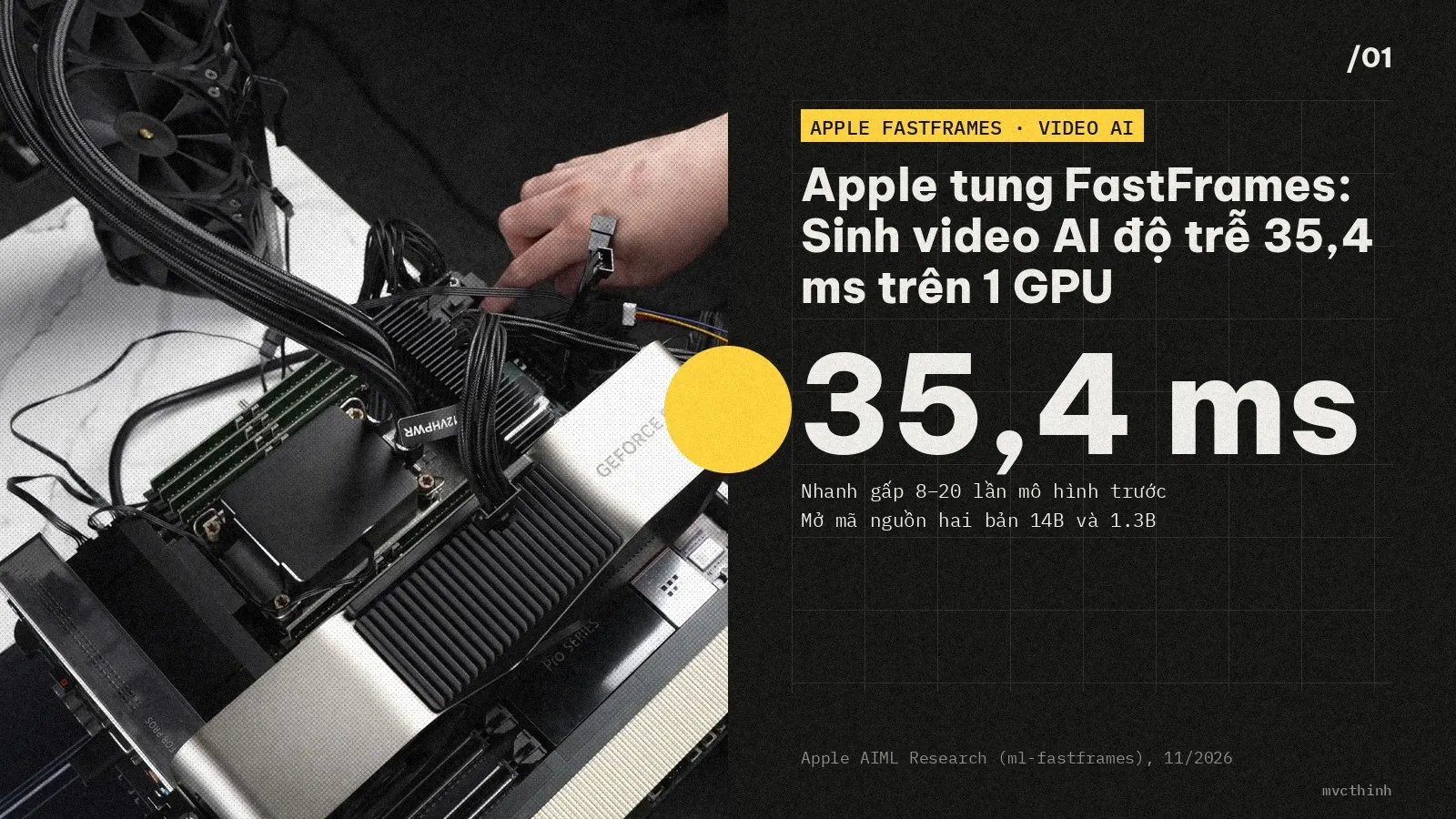
Generating a short AI video clip usually means waiting long enough to grab a coffee before seeing the first frame, yet in November 2026 Apple AIML researchers released FastFrames, an open-weight model family that generates 480p video at 35.4 ms step latency on a single GPU. Rather than shrinking the diffusion backbone alone, the team targeted two often-overlooked stages: pixel decoding and KV cache updates.
How do FastFrames-S (1.3B) and FastFrames-L (14B) compare?
Apple released two two-step autoregressive diffusion variants aimed at distinct workloads, both generating 832 × 480 clips (81 frames at 16 fps). Alongside them, the team published an optimized build of LingBot-World v2 1.3B that runs 16x faster than the upstream implementation for keyboard-controlled camera navigation.
- FastFrames-S (1.3B parameters): Freezes a two-step frame-wise
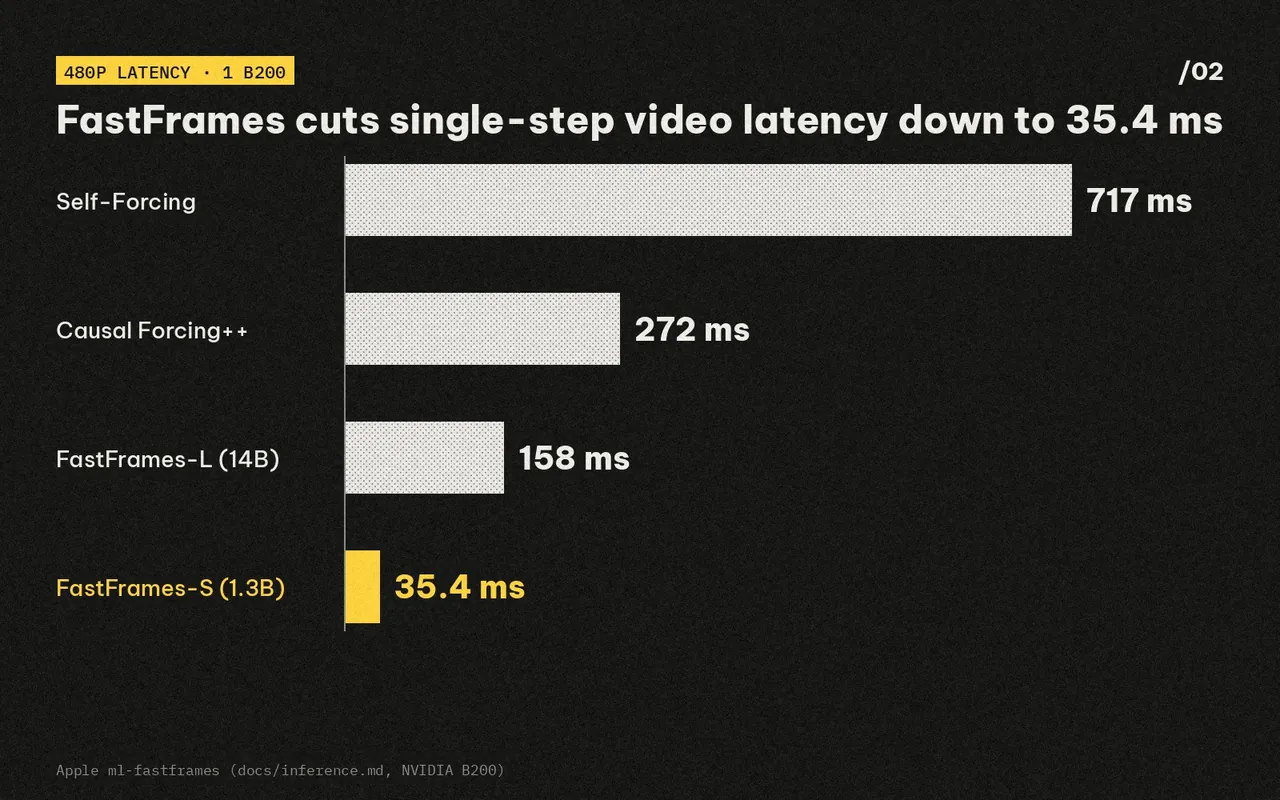
Causal Forcing++generator and trains only the surrounding pixel decoder and KV refinement module. On one NVIDIA B200 GPU, it hits 35.4 ms per four-frame RGB step (dropping to 14 ms across eight GPUs), opening the door to real-time interactive worlds. - FastFrames-L (14B parameters): Distilled from
Wan2.1-T2V-14B, trading raw speed for noticeably sharper lighting, shadows, composition, and in-scene text rendering. It runs at 158 ms per step on one B200 GPU (45 ms across eight GPUs), matching Krea-Realtime quality while running over 10x faster.
| Model | VBench Total | VBench Quality | 1-GPU Latency (B200) | 8-GPU Latency (B200) |
|---|---|---|---|---|
| CausVid | 83.18 | 84.15 | — | — |
| Self-Forcing | 84.10 | 84.84 | 717 ms | — |
| Causal Forcing++ | 84.11 | 85.09 | 272 ms | — |
| FastFrames-S (1.3B) | 84.23 | 85.30 | 35.4 ms (paper: 36 ms) | 14 ms |
| FastFrames-L (14B) | 84.44 | 85.48 | 158 ms | 45 ms |
How Apple broke the 35.4 ms bottleneck
Most speed-focused video papers try to cut diffusion denoising steps down to one or two passes, yet Apple's component profiling showed that two surrounding operations—decoding latents to pixels and updating the KV cache—were eating a huge share of wall-clock latency.
flowchart LR
  A[2-step DiT: 32.3 ms]:::data --> B[KV refinement: 2.2 ms]
  B --> C[Pixel decoder: 0.9 ms]:::key
  C --> D[4 RGB frames at 480p]
  classDef key fill:#1d1a10,stroke:#ffd23f,color:#ffd23f,stroke-width:1.6px
  classDef human fill:#181817,stroke:#e8e6df,color:#e8e6df,stroke-dasharray:5 3
  classDef data fill:#1c1c1b,stroke:#8d8b85,color:#cfcdc6
  classDef muted fill:#181817,stroke:#3d3d3a,color:#8d8b85
First, VAE decoding—the step that converts compressed latent representations back into visible RGB pixels—was replaced with a compact streaming pixel decoder. In FastFrames-S, decoding a latent frame takes just 0.9 ms, eliminating the stall caused by calling a heavy full-frame VAE at every interactive chunk.
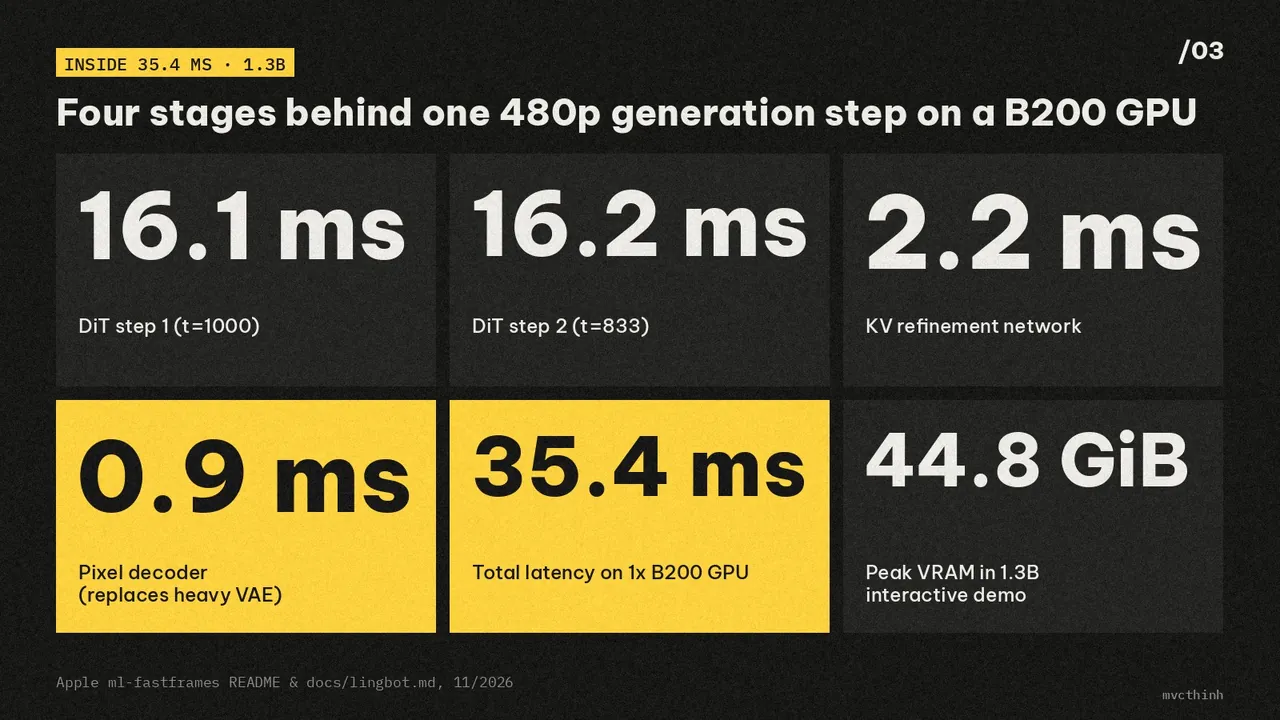
Second, KV cache updates—which keep characters and camera geometry consistent across generated frames—no longer require a dedicated clean DiT pass as in Causal Forcing++. Instead, a compact KV refinement network updates cache states in 2.2 ms. Combined with the two DiT evaluations (16.1 ms at t=1000 and 16.2 ms at t=833), the entire pipeline lands at 35.4 ms.
 Also readTurning a 2D Painting Into a 3D Scene With Opus 5.5 in toEdit
What this means for local video creators
Interactive latency sounds immediately usable on a desk rig, yet creators running 8–16 GB consumer GPUs or Apple Silicon Macs cannot deploy these checkpoints out of the box just yet. Apple's numbers come from data-center hardware under a narrow software stack.
Before local video editors see millisecond feedback on everyday machines, the open-source ecosystem will need quantized checkpoints (such as FP8 or INT4) or Apple Silicon MLX ports. Even so, the release proves that stripping away VAE and KV bottlenecks matters just as much as shrinking model weights—especially as rising memory and hardware costs for local AI push creators to squeeze more out of every gigabyte, while NVIDIA and CUDA remain central even for research shipped by Apple.
My take
For editors and solo creators, the worst friction in AI video today is not rendering the final polished clip—it is waiting one or two minutes per prompt just to test a camera angle or pacing idea, burning credits every time the framing misses.
Once frame latency drops into the tens of milliseconds, video generation shifts from "submit and wait" to live interactive storyboarding. Consumer cards and Apple Silicon Macs still need quantization and runtime ports to catch up, but Apple's profiling roadmap shows clearly how local AI video stops feeling like a slow render queue.
Sources
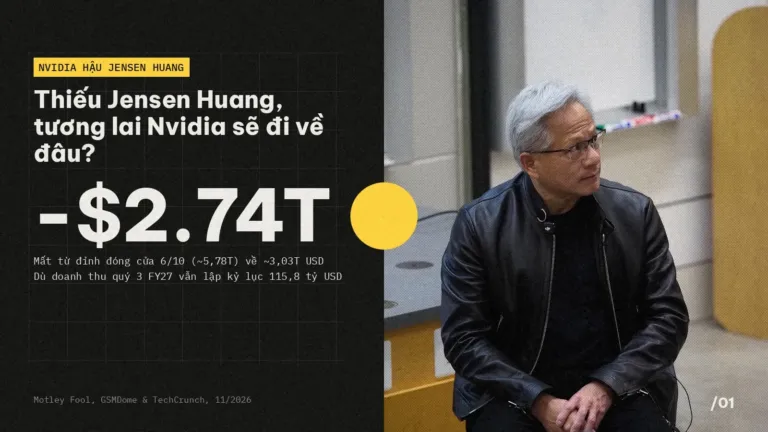 Safety & policy · Nov 21, 2026Nvidia Without Jensen Huang: Where Do CUDA and GPUs Go?
Analyzing Nvidia after Jensen Huang: the 60-report leadership gap, Claude Mythos and AMD pressure on CUDA, and what GPU buyers face next.
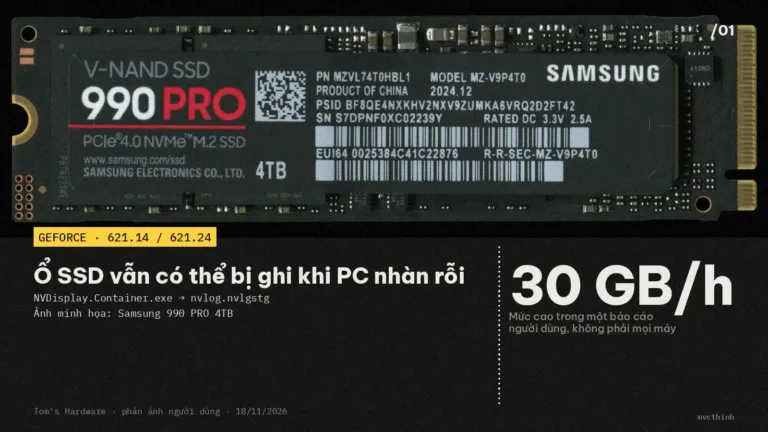 AI video · Nov 20, 2026NVIDIA driver SSD writes: Check with Resource Monitor
GeForce 621.14/621.24 users report 3–30 GB/hour of idle writes. Check NVDisplay.Container.exe, monitor SSD writes, and consider rolling back to 621.01.
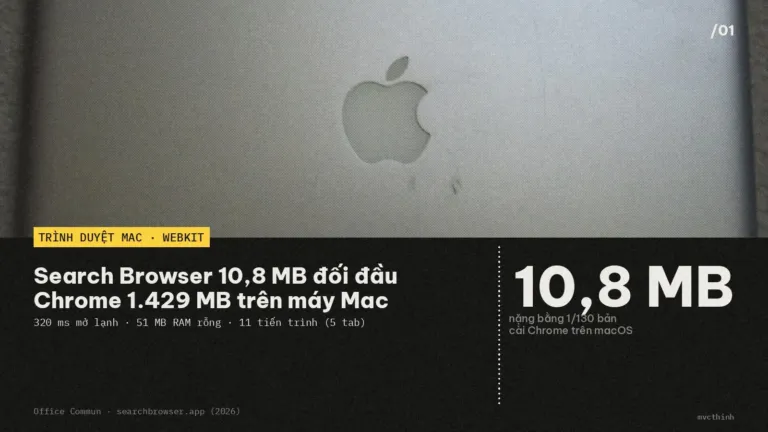 MCP & tools · Nov 19, 2026Search Browser vs Chrome: Is a 10.8 MB Mac Browser Worth It?
A practical comparison of Search Browser v1.0.14 (WebKit) vs Chrome on macOS: real benchmarks, Arc-style features, extension limits, and who should switch.