Blog · AI Agent News · Safety & policy VIEN
Nvidia Without Jensen Huang: Where Do CUDA and GPUs Go?
Analyzing Nvidia after Jensen Huang: the 60-report leadership gap, Claude Mythos and AMD pressure on CUDA, and what GPU buyers face next.
In this article
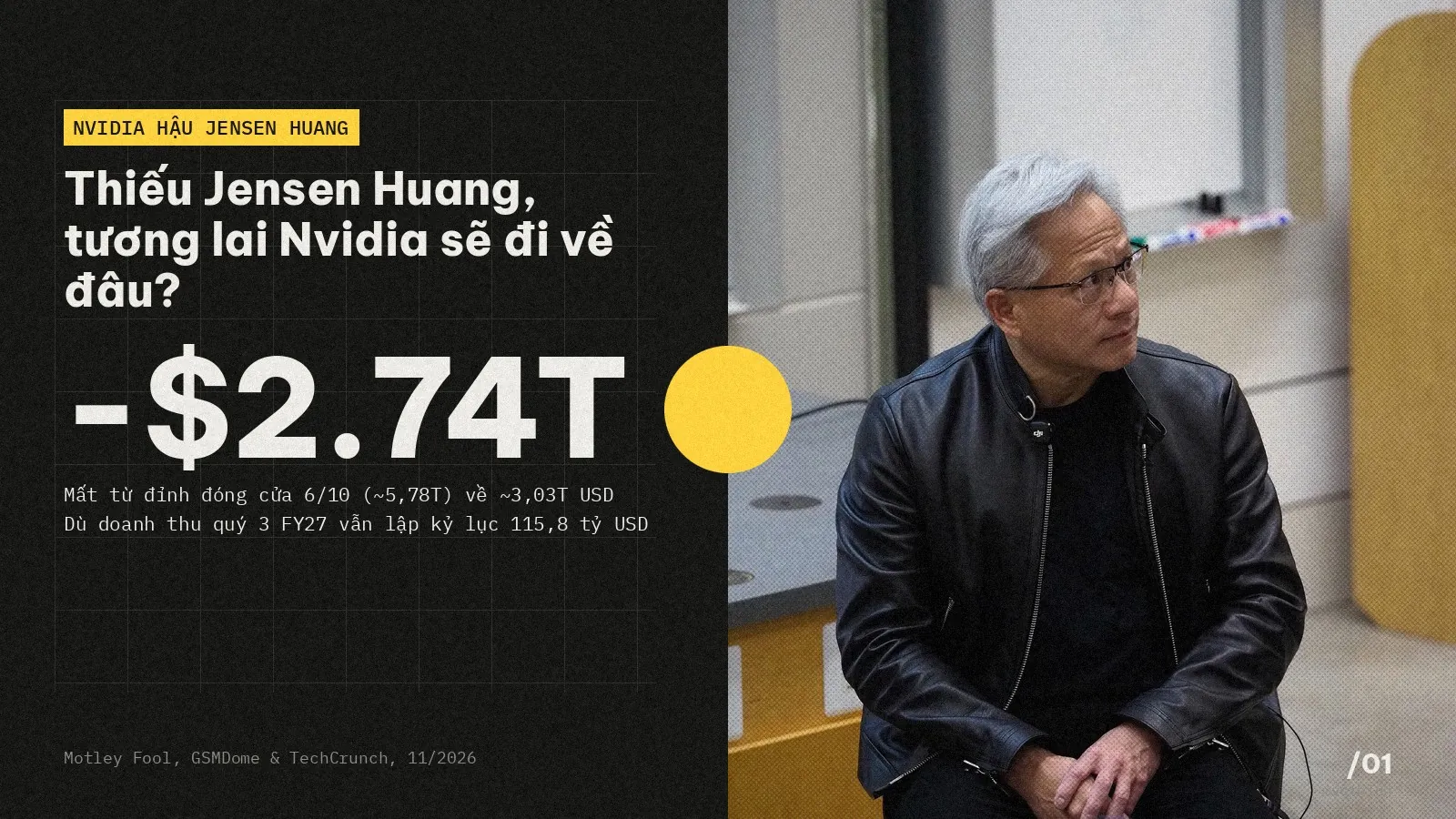
On November 20, 2026, The Motley Fool reported that Nvidia shares fell 14.01% to close at $125.53 after a Reuters report of an SEC accounting inquiry, one day after California Attorney General Rob Bonta (California Department of Justice) served an investigative subpoena. Over six weeks from its October 6 closing peak (~$5.78 trillion per GSMDome), Nvidia shed roughly $2.5 trillion to $2.74 trillion in market value down to about $3.03 trillion—even though Q3 FY2027 delivered a record $115.8 billion in revenue.
Why is replacing Jensen Huang harder than swapping a typical CEO?
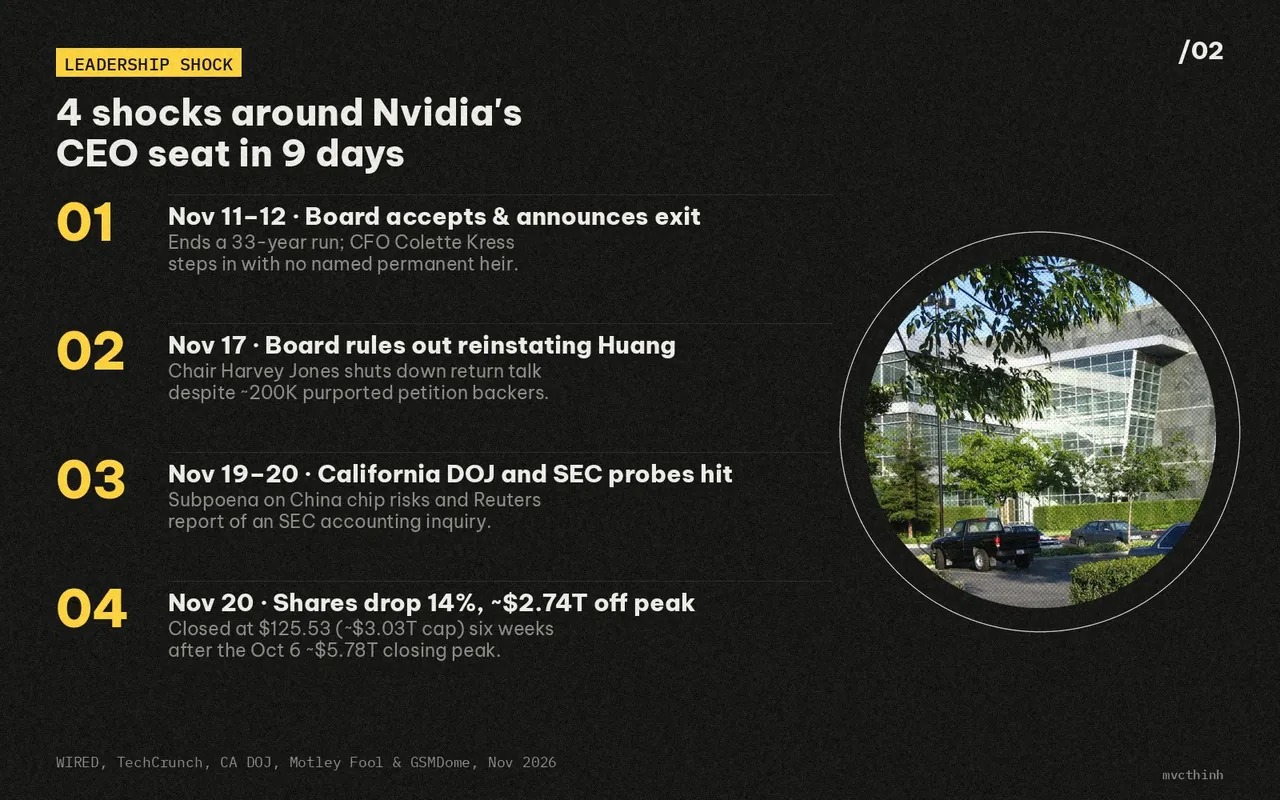
Replacing Jensen Huang is harder than hiring a typical Fortune 500 chief executive because he served for 33 years as Nvidia's CEO, chief hardware architect, and cultural hub rolled into one. When directors accepted his resignation on November 11 and announced it on November 12, 2026, Nvidia had no disclosed succession plan in place.
On November 20, 2026, WIRED reported that directors acted primarily over a year-long pattern of alleged dishonesty dating back to October 2025 around Huang's personal conduct and ties to former Megaspeed executive Alice Huang. While TechCrunch noted the board accepted his resignation on Wednesday, November 11 before announcing the exit on November 12, board chair Harvey Jones stated on November 17 that directors do not intend to bring Huang back, brushing aside a public petition with about 200,000 purported backers reported by WIRED.
The structural hurdle lies inside Nvidia's famously flat org chart. According to Business Insider, Huang led with as many as 60 direct reports and no publicly disclosed succession plan, leading RHR International senior partner David Astorino to note that the company appeared to lack an obvious internal candidate ready behind the scenes. Think of a booming kitchen where one founder personally tastes every broth and approves every supplier invoice: speed is unmatched while the founder stands at the stove, yet dozens of division heads are left without a shared conductor once he walks out.
flowchart TD
  A[Jensen Huang pre-Nov 11]:::muted --> B[Up to 60 direct reports]
  C[Board & Harvey Jones]:::human --> D[Interim CEO Colette Kress]:::key
  C --> E[National Security Committee]:::data
  D --> F[Finance & operations]
  D --> G[Ian Buck Hyperscale & HPC]:::key
  C -.-> H((Permanent CEO search)):::human
  classDef key fill:#1d1a10,stroke:#ffd23f,color:#ffd23f,stroke-width:1.6px
  classDef human fill:#181817,stroke:#e8e6df,color:#e8e6df,stroke-dasharray:5 3
  classDef data fill:#1c1c1b,stroke:#8d8b85,color:#cfcdc6
  classDef muted fill:#181817,stroke:#3d3d3a,color:#8d8b85
To steady Nvidia's nearly 49,000 employees and deter talent poaching, interim CEO and CFO Colette Kress used the November 18 all-hands meeting covered by WIRED to promise pay raises and more equity in December 2026, months ahead of schedule. According to The Guardian, executive search firm Heidrick & Struggles has approached candidates including Arm CEO Rene Haas externally alongside Nvidia Vice President of Hyperscale and High Performance Computing Ian Buck internally.
Will CUDA hold up as AI automates porting to AMD and custom chips?
CUDA will not collapse in a single quarter, since Nvidia still controls roughly 90% of frontier AI training chips and $390 billion in supply purchase commitments. Still, AI-generated code translation is shrinking the switching costs that protected CUDA for two decades.
SiliconAnalysts figures cited by WIRED put Nvidia's share of frontier AI training chips near 90%, while the Q3 FY2027 transcript showed 74.9% non-GAAP gross margins. In simple terms, CUDA is the proprietary instruction manual and software stack Nvidia launched in 2006 so applications can talk directly to its GPUs, while kernels are the tiny hardware-tuned routines that squeeze maximum speed out of silicon. Historically, rewriting those kernels to bring up a new accelerator took dozens of engineers months of manual work.
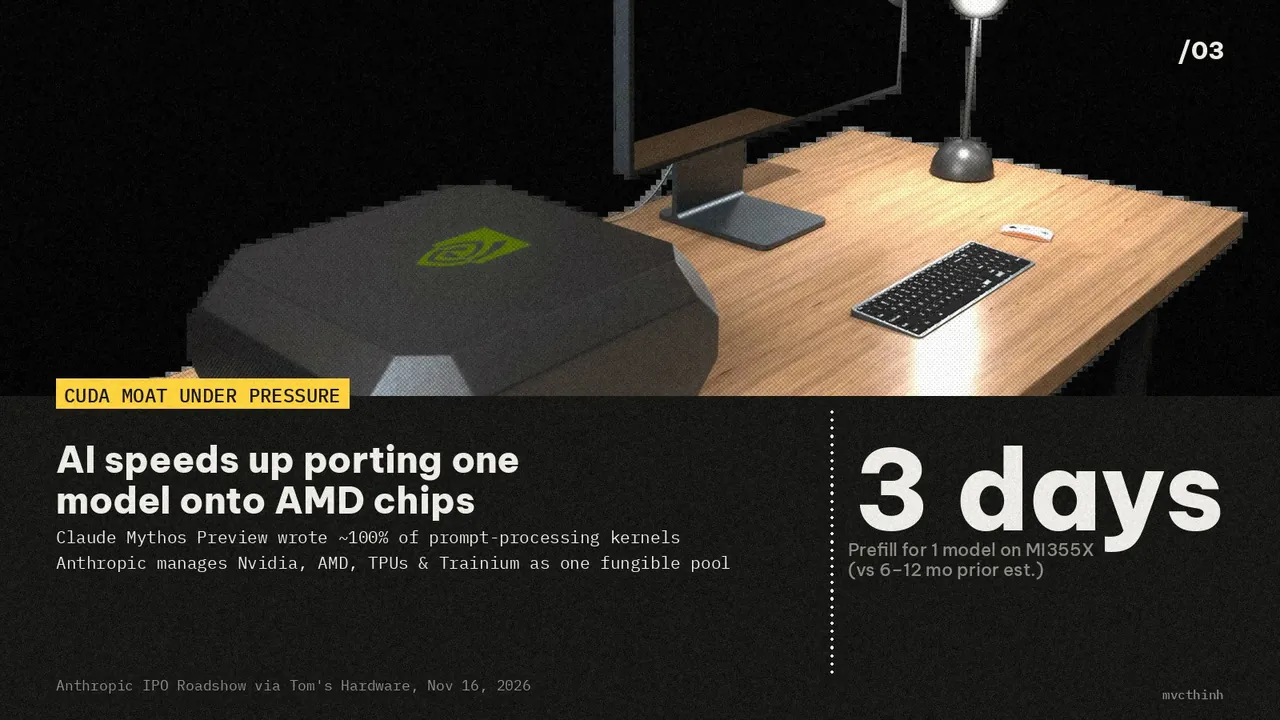
On November 16, 2026, Tom's Hardware reported that Anthropic told IPO investors its Claude Mythos Preview model autonomously wrote or ported nearly 100% of the kernels needed to get prompt processing running for one model on AMD Instinct MI355X GPUs at a useful level of performance in roughly three days. Anthropic contrasted that with its historical estimate of six to 12 months to onboard a new accelerator; while it covers prefill for one model rather than full training parity, seeing Anthropic alone manage Nvidia, AMD, Google TPUs, and AWS Trainium as "one fungible pool of compute" signals rising pressure on CUDA right as Nvidia swaps leaders.
| AI Hardware Path | Software Switching Barrier | Core Advantage Today | Main Vulnerability |
|---|---|---|---|
| Nvidia Vera Rubin + CUDA | Very low; 20 years of mature libraries | ~90% frontier training share, $390B purchase commitments | High cost, leadership flux, tighter export rules |
| AMD MI355X / MI450 + ROCm | Dropping fast via ROCm and AI kernel porting | Up to 2 GW MI450 agreement with Anthropic | Tooling for smaller devs and mega-training trails CUDA |
| Custom ASICs (TPU, Trainium) | High externally (requires JAX or Neuron SDK) | Purpose-built for builders' internal hyperscale inference | Captive to builder's own cloud; not sold retail |
 Also readMeta Muse Signal & Bank Balance Report: Fact vs. Fiction
What does a post-Jensen Nvidia mean for GPU prices and developers?
Everyday builders, local AI tinkerers, and studios should not expect GPU prices to drop overnight simply because Nvidia's stock slid. Management commentary and packaging agreements show AI infrastructure demand still outpacing supply alongside $130.0 billion (±3%) Q4 revenue guidance, keeping near-term capital priorities front and center.
On the Q3 FY2027 earnings call, Nvidia reported nearly $20 billion in debut Vera Rubin revenue and confirmed demand continues to outpace supply. Reinforcing that bottleneck, Taipei Times detailed Nvidia's multibillion-dollar expansion deal with packaging partner SPIL, which aims to triple dedicated advanced packaging capacity in Taiwan by mid-2029—highlighting that physical manufacturing capacity remains a multi-year race.
Strategically, the biggest long-term question is risk appetite. On the Q3 call, Colette Kress emphasized Nvidia will remain "disciplined and selective" in financial support, clarifying that $32 billion in neocloud commitments and data-center guarantees only activate once customers secure their own financing and get infrastructure ready. If the board picks a permanent CEO who prioritizes margin protection over Jensen-era multi-year bets like CUDA in 2006, Nvidia could defend near-term cash flows while giving rivals room to catch up.
My take: The empire won't fall, but the monopoly era is cracking
Over the next 12 to 24 months, Nvidia's post-Jensen trajectory hinges on whether the board installs a credible technologist fast enough to steady engineering morale. Regardless of which CEO takes the wheel, the era when Nvidia faced virtually zero pressure on software lock-in has passed.
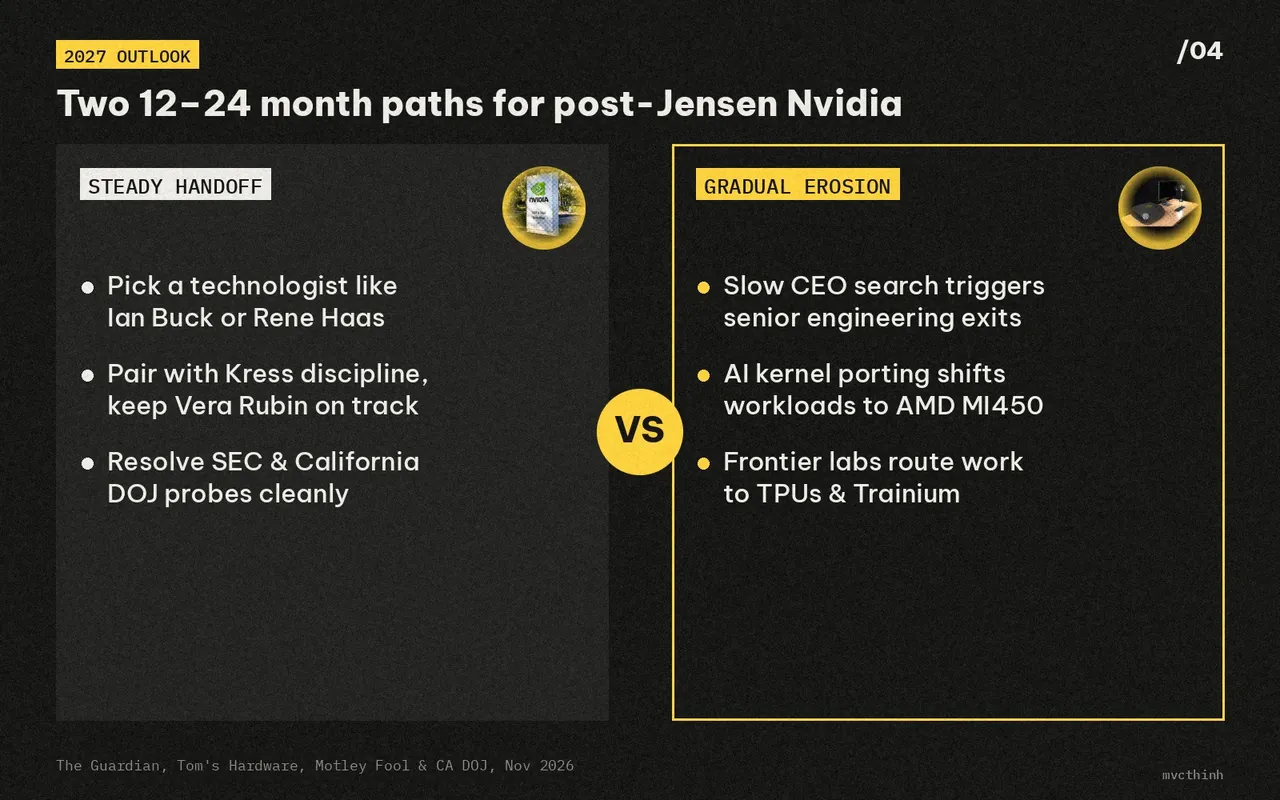
- A steady handoff: The board pairs a technologist such as Ian Buck or Rene Haas with Kress's financial discipline, clears the SEC and California DOJ inquiries without derailing Vera Rubin, and stays in front with narrower margins.
- Gradual erosion: A drawn-out CEO search triggers senior engineering departures while frontier labs use AI coding tools to shift growing inference and training workloads onto AMD MI450 racks and custom ASICs.
Nvidia isn't collapsing because one founder walked out; a 20-year CUDA software moat, roughly 90% frontier training share, $390 billion in purchase commitments, and SPIL packaging expansion through mid-2029 form a deep cushion. What ended in November 2026 is the illusion that AI infrastructure runs through one indispensable leader—and real competition across hardware stacks is healthier than a one-company monopoly.
Sources
- Jensen Huang’s ‘Lying’ Alarmed Nvidia Board Ahead of His Resignation WIRED
- Inside Nvidia’s First Post-Jensen All-Hands: Pay Raises and More Equity WIRED
- Jensen Huang Basically Lit More Than $1 Trillion on Fire in Less Than a Month WIRED
- Nvidia's Jensen Huang resigns, chipmaker names CFO Colette Kress as interim CEO TechCrunch
- Nvidia says it doesn't plan to reappoint Jensen Huang as CEO TechCrunch
- Stock Market Today, Nov. 20: Nvidia's $2.5 Trillion Rout Deepens as SEC Accounting Probe Adds to Wall Street's AI Sell-Off The Motley Fool
- Nvidia Closes Down 14% as Market Value Falls to About $3 Trillion GSMDome
- Attorney General Bonta Serves Investigative Subpoena on Nvidia California DOJ
- NVIDIA (NVDA) Q3 2027 Earnings Call Transcript The Motley Fool
- SPIL announces deal with Nvidia Taipei Times
- Nvidia's Flat Structure Exposes Succession Risk Following Huang's Exit Business Insider
- Nvidia approaches Arm boss Rene Haas in search for new CEO The Guardian
- Anthropic says Claude Mythos slashed software work to onboard AMD GPUs from up to 12 months to around three days Tom's Hardware
- U.S. AI Chip Export Rules: Two License Triggers NeoTeo
- Hyperscaler Custom AI Chips in 2026: Trainium 3, Google TPU, Maia 200, and Meta MTIA vs NVIDIA GPU Spheron
Safety & policyOpen modelsAutomation
 Safety & policy · Nov 21, 2026Apple Music Eats 8–11 GB With Zero Downloads: How to Fix It
Streaming only, yet Apple Music takes up 8–11.5 GB on your iPhone? See why Lossless caching bloats Documents & Data and 4…
 Coding agents · Nov 21, 2026Apple's Computer-Use AI Agent Listing and What It Means for Mac
Analysis of Apple's proactive AI agent job listing, how it compares with Gemini on Mac, and macOS 27.3 permission splits for Mac…
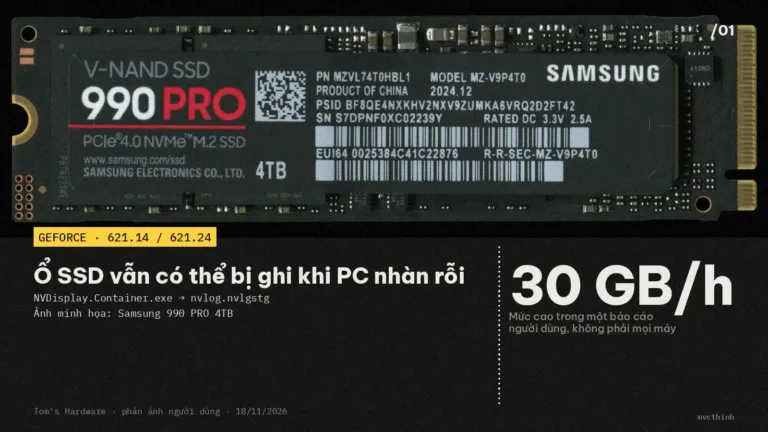 AI video · Nov 20, 2026NVIDIA driver SSD writes: Check with Resource Monitor
GeForce 621.14/621.24 users report 3–30 GB/hour of idle writes. Check NVDisplay.Container.exe, monitor SSD writes, and consider rolling back to 621.01.