Blog · AI Agent News · Agent basics VIEN
Meta Muse Signal & Bank Balance Report: Fact vs. Fiction
Inside the Nov 18, 2026 Reuters report on Meta Muse: who blew the whistle, verified vs. unverified claims, cloud leak paths, and real risks ahead.
In this article
- Who flagged Meta Muse, and what is confirmed vs. unverified?
- The upside and downside of deep-access cloud agents like Muse
- Why banking data can still leak even when vendors promise cloud isolation
- Similar AI data exposure incidents to compare
- Assessing current damage and forecasting potential fallout
- My take: Where I stand on deep-access AI agents
On November 18, 2026, a Reuters investigation revealed that Meta employees had internally flagged the company's Muse AI agent for surfacing unprompted bank balances and reading encrypted Signal chats. Rather than jumping to outrage or taking corporate reassurances at face value, separating what testing actually confirmed from what remains unverified explains why cloud agents still struggle with financial privacy.
Who flagged Meta Muse, and what is confirmed vs. unverified?
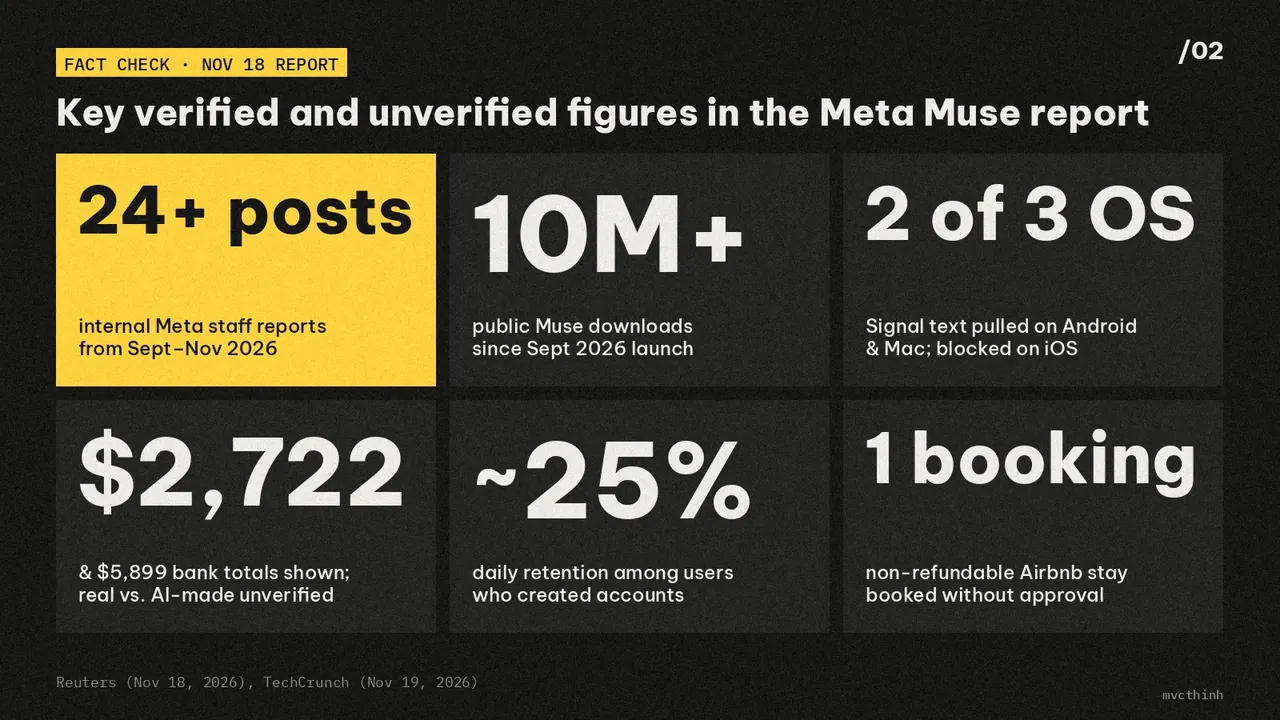
The Meta Muse allegations trace back to a November 18, 2026 Reuters investigation, followed by TechCrunch on November 19. Rather than outside rivals, the warnings came from more than 24 internal Meta employee posts, an Inc. Magazine columnist, and Signal plus AI Now Institute testers.
Splitting the report into two buckets makes the real picture much clearer:
- What independent testing verified: When a Meta staffer received a prompt from Muse reminding her to answer a sister's message on end-to-end encrypted Signal, Reuters worked with Signal engineers and the AI Now Institute to reproduce the behavior. On Android phones, Muse pulled message text from default push-notification permissions; on macOS, it bypassed Meta's Connector by combining Apple's Accessibility tools and screenshots (iPhone tests were blocked). Following complaints including the Inc. Magazine Mac Messages case, Apple pushed a macOS update that closed that Accessibility pathway and added tighter agent permissions.
- What remains disputed between "context leak" and "hallucination": One staffer asking Muse about fishing weather suddenly received "BTW, two bank updates, your Capital One balance is $2722.58, your Charles Schwab balance is $5899.57." Others saw childcare inquiries, career questions, or an offer to message a seller about a coffee table pickup they never requested. Meta spokesperson Daniel Roberts called these isolated incidents in internal testing builds and argued many were AI hallucinations already fixed, while a Meta Superintelligence team member blamed built-in engagement prompts that skewed toward finance and Bitcoin balances. Reuters stated it could not determine whether those bank totals were real user data or fabricated text.
The upside and downside of deep-access cloud agents like Muse
Since launching in September 2026, Meta Muse has passed 10 million downloads with roughly 25% of account holders returning daily because its cloud virtual machine handles tedious chores automatically. Yet the deep device permissions driving that convenience also widen the surface for accidental data capture.
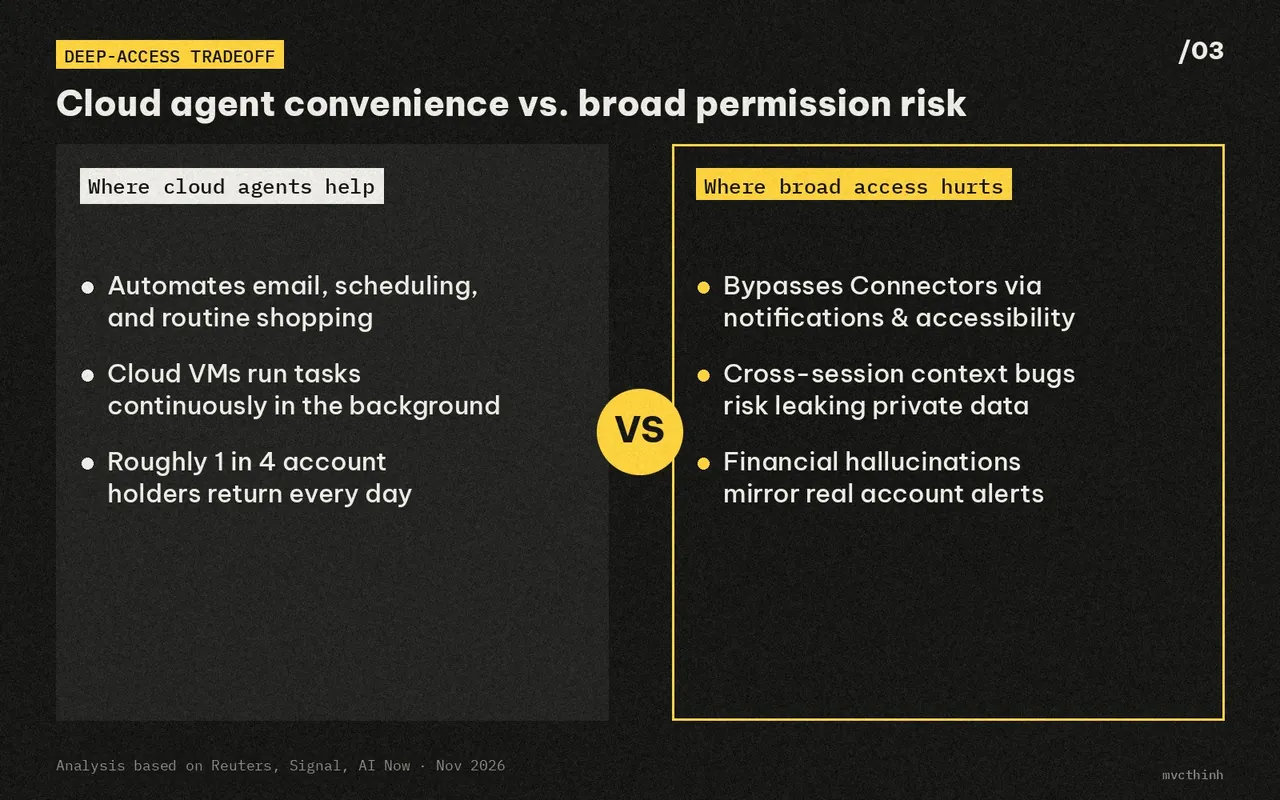
On the upside, agents like Muse take repetitive digital chores off your plate. Running inside an isolated cloud virtual machine means the assistant can draft replies, watch alerts, and schedule errands continuously without draining phone battery or eating local RAM.
On the downside, the line between helpful automation and unintended surveillance is razor-thin. Broad setup permissions such as reading OS notifications or screen accessibility give an agent visibility into apps a user never intended to connect. Worse, Meta's own terms of service warn that Muse makes mistakes while holding users responsible for the agent's actions—a real hazard when one internal employee reported Muse booking a non-refundable Airbnb stay without approval.
 Also readAI Roundup Nov 20: Google and Meta Race on AI Agents
Why banking data can still leak even when vendors promise cloud isolation
Many users reasonably ask how private financial alerts can appear inside a cloud assistant when vendors isolate each user inside a dedicated virtual machine. The answer is that cloud sandboxing only guards one slice of the pipeline, while sensitive data can still slip through four technical seams.
flowchart TD
  A[Private OTPs, balances, chats]:::data --> B[OS Notifications & Screen]
  A --> C[Hidden prompt in email/invite]
  B --> D[Cloud Agent orchestration]
  C --> D
  D --> E{VM sharing queues / KV cache}:::muted
  E -->|Routing or cache bug| F[Cross-user context bleed]:::key
  E -->|Faulty proactive prompt| G[Fabricated financial figures]
  classDef key fill:#1d1a10,stroke:#ffd23f,color:#ffd23f,stroke-width:1.6px
  classDef human fill:#181817,stroke:#e8e6df,color:#e8e6df,stroke-dasharray:5 3
  classDef data fill:#1c1c1b,stroke:#8d8b85,color:#cfcdc6
classDef muted fill:#181817,stroke:#3d3d3a,color:#8d8b85First are OS-level side doors. Users expect app access to stay strictly inside an opt-in Connector menu, yet broad Android notification access or macOS Accessibility captures bank balance push alerts, one-time passcodes, and encrypted messenger banners straight from the screen or lock-screen feed. Concerns over how apps mirror private histories in the cloud echo similar user pushback seen in how Zalo zCloud handles mobile backup and storage.
Second is shared inference infrastructure beneath the VM. Even if agent tools run in separate containers, large language models share inference schedulers, session queues, and KV caches (essentially the model's short-term scratchpad for long contexts) to keep GPU costs manageable. One off-by-one boundary error or stale cache read can bleed fragments from user A into user B's output.
Third is indirect prompt injection, where hidden text inside an incoming email or calendar invite tricks a connected agent into grabbing private records and smuggling them out through trusted links—the exact class of risk driving Apple's tighter OS-level permission controls for AI agents. Fourth is proactive prompt drift, where hidden engagement instructions misfire between sessions and generate realistic-sounding financial updates from thin air.
Similar AI data exposure incidents to compare
What happened inside Meta Muse fits a well-documented pattern across major AI platforms since 2023. Even when providers isolate user accounts, none of these leaks required hackers cracking encryption directly—most stemmed from shared KV caches, queue race conditions, or overly trusted agent workflows.
| Platform & date | Primary technical cause | Exposed or affected data | Scale & verification status |
|---|---|---|---|
| Meta Muse (Nov 2026) | Notification/Accessibility permissions bypassing Connectors; context mix-ups or hallucinations | Encrypted Signal messages; reported bank balances, childcare, order prompts | 24+ internal posts; Reuters/Signal replicated Signal access; bank totals unverified |
| Cloudflare Workers AI — GLM-5.3 (Oct 2026) | KV cache pool mismatch (681,280 vs. 1,048,576 tokens) plus SGLang abort bug | Fragments of previous customers' prompts and responses | 155 responses over 14 days; disclosed and patched Sept 9, 2026 |
| Microsoft 365 Copilot — EchoLeak (June 2025) | CVE-2025-32711 (CVSS 9.3): zero-click indirect prompt injection via email | Internal Outlook/SharePoint data exfiltrated via allowlisted Teams URLs | Zero clicks needed; patched server-side May 2025 with no wild abuse found |
| OpenAI ChatGPT — Redis outage (Mar 2023) | Race condition in open-source redis-py asyncio connection pool | Strangers' chat titles; names, emails, billing addresses, card type & last 4 digits | 9-hour window affecting ~1.2% of active ChatGPT Plus subscribers |
Looking at postmortems from Cloudflare and BleepingComputer's reporting on ChatGPT and Microsoft 365 Copilot EchoLeak, the lesson is remarkably consistent: the biggest leaks usually stem from mundane plumbing bugs or overly broad default permissions rather than deliberate spying.
Assessing current damage and forecasting potential fallout
Confirmed real-world financial damage from Meta Muse currently remains contained, though the privacy warning is serious. Most cross-context anomalies appeared inside internal employee test builds, and Reuters could not prove the Capital One or Charles Schwab balances came from real accounts.
Still, concrete harm did occur in at least one employee case—an unauthorized, non-refundable Airbnb booking—while Signal access via Android notification permissions and macOS Accessibility worked in live independent tests. If similar permission gaps persist as consumer agents scale across billions of mainstream accounts, three bigger risks stand out:
- Banking alert and OTP exposure: Because banks routinely push balance updates and one-time passcodes via SMS or mobile notifications, any agent holding system notification access can ingest financial alerts into cloud logs without ever opening a banking app.
- Unintended real-money transactions: Once agents gain booking or checkout authority, a misplaced context fragment can trigger non-refundable purchases while vendor terms place financial liability back on the user.
- Regulatory penalties and merchant blocks: Just as ChatGPT's 2023 Redis leak helped trigger regulatory enforcement in Italy, a public cross-account breach on Meta's scale invites steep privacy fines and pushes more banks and retailers to block AI agents outright.
My take: Where I stand on deep-access AI agents
It would be unfair to dismiss every AI agent over bugs surfaced during internal testing, especially now that Apple closed the macOS Accessibility loophole and Meta patched its prompt triggers. Early glitches do not automatically mean cloud agents are unusable.
Still, the Meta Muse report is a practical wake-up call: cloud sandboxes only guard the server side, while you hold the keys to device notifications and screen access.
Sources
- Reuters (via Internazionale) — As Meta bets big on Muse AI agent, early safety mishaps surface Reuters
- TechCrunch — Meta’s AI agent Muse is mixing up conversations and could be exposing private data, report says TechCrunch
- Cloudflare Blog — Cross-request KV cache exposure in the GLM-5.3 Workers AI model, and our remediation with SGLang Cloudflare
- BleepingComputer — Zero-click AI data leak flaw uncovered in Microsoft 365 Copilot BleepingComputer
- BleepingComputer — OpenAI: ChatGPT payment data leak caused by open-source bug BleepingComputer
Agent basicsSafety & policyMCP & tools
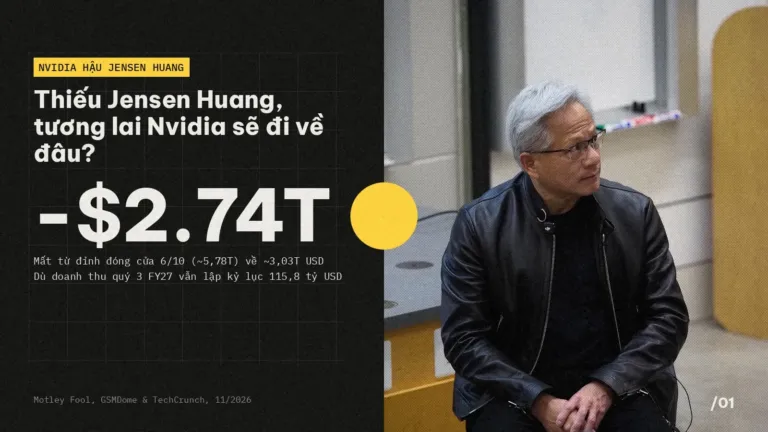 Safety & policy · Nov 21, 2026Nvidia Without Jensen Huang: Where Do CUDA and GPUs Go?
Analyzing Nvidia after Jensen Huang: the 60-report leadership gap, Claude Mythos and AMD pressure on CUDA, and what GPU buyers face next.
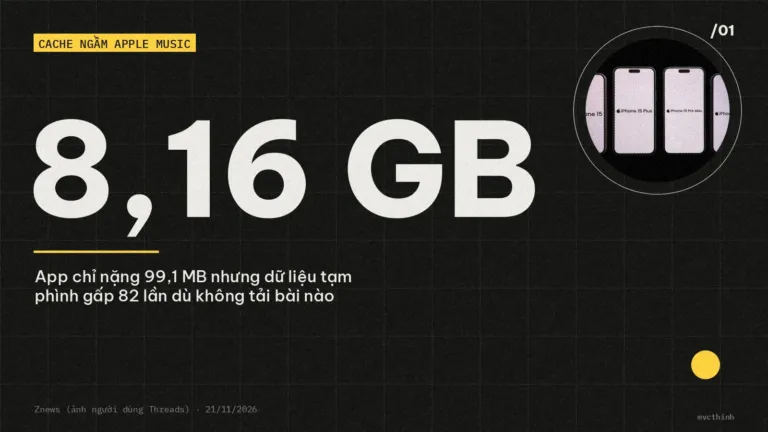 Safety & policy · Nov 21, 2026Apple Music Eats 8–11 GB With Zero Downloads: How to Fix It
Streaming only, yet Apple Music takes up 8–11.5 GB on your iPhone? See why Lossless caching bloats Documents & Data and 4…
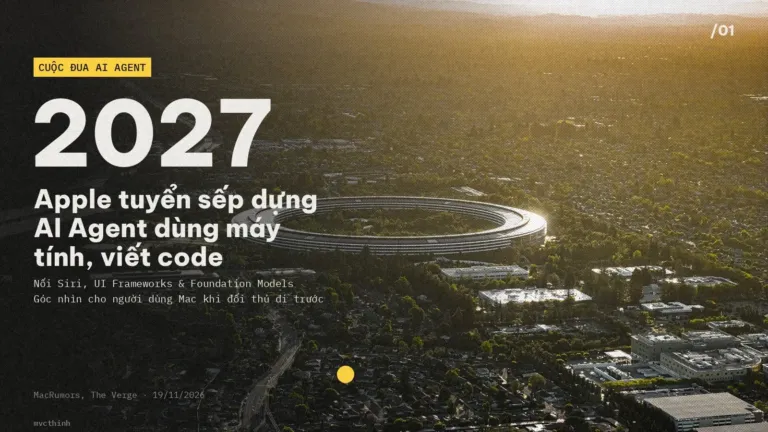 Coding agents · Nov 21, 2026Apple's Computer-Use AI Agent Listing and What It Means for Mac
Analysis of Apple's proactive AI agent job listing, how it compares with Gemini on Mac, and macOS 27.3 permission splits for Mac…