Blog · AI Agent News · Coding agents VIEN
Apple's Computer-Use AI Agent Listing and What It Means for Mac
Analysis of Apple's proactive AI agent job listing, how it compares with Gemini on Mac, and macOS 27.3 permission splits for Mac users.
In this article
On November 19, 2026, Google added Computer Use to Gemini for Mac, letting the assistant click, type, and complete workflows in an isolated background window. That same day, Bloomberg spotted an Apple listing for a Senior Engineering Manager, Agentic AI (Proactive) leading a team building general-purpose computer-use agents that browse the web, work across apps, run command lines, and write or debug code.
How Apple plans to bridge 3 teams for computer-use agents
According to the job posting spotted by Bloomberg on November 19, 2026 and reported by MacRumors and The Verge, Apple wants an engineering leader who can work directly across its Siri, UI Frameworks, and Apple Foundation Models divisions.
In simple terms, UI Frameworks powers the buttons, windows, and interface layers across Apple operating systems, while Apple Foundation Models supplies Apple's in-house AI models. Upgraded Siri AI, which began rolling out in September 2026, already includes on-screen awareness for answering questions and acting across apps, and iOS 27.3 Developer Preview lets third-party apps build multi-step app skills for Siri (The Verge).
By contrast, the November 19 listing targets a broader frontier: general-purpose computer-use agents that move fluidly across a browser, documents, command lines, editors, code, and APIs while coordinating specialized sub-agents. Notice that Apple's listing does not confirm whether this product is built exclusively for Mac or spans multiple Apple devices; examining it through a Mac lens here reflects the competitive pressure now unfolding on macOS.
flowchart TD
  A[Siri Team]:::data --> D[Agentic AI Group]:::key
  B[UI Frameworks]:::data --> D
  C[Apple Foundation Models]:::data --> D
  D --> E[Web & cross-app workflows]
  D --> F[Command line & code debugging]
  D --> G[Sub-agent orchestration]
  H((Privacy & safety at core)):::human --> D
  classDef key fill:#1d1a10,stroke:#ffd23f,color:#ffd23f,stroke-width:1.6px
  classDef human fill:#181817,stroke:#e8e6df,color:#e8e6df,stroke-dasharray:5 3
  classDef data fill:#1c1c1b,stroke:#8d8b85,color:#cfcdc6
  classDef muted fill:#181817,stroke:#3d3d3a,color:#8d8b85
Apple also states in the listing that safety, privacy, and security must be "central to the design" and that the agent should operate "privately and with the polish people expect from Apple." Still, public sources do not describe the project's data flows or confirm whether screen and file processing stays strictly on-device or involves servers.
How far behind Meta, OpenAI, Anthropic, and Google is Apple?
Comparing product timelines since September 2026 shows Apple trailing rivals by a beat in proactive computer-use tools: while competitors already ship agents or Mac desktop control, Bloomberg reported on November 8, 2026 (MacRumors) that Siri could function "more like an agent" as early as 2027, adding that even if the plan moves forward, the exact implementation remains to be seen.
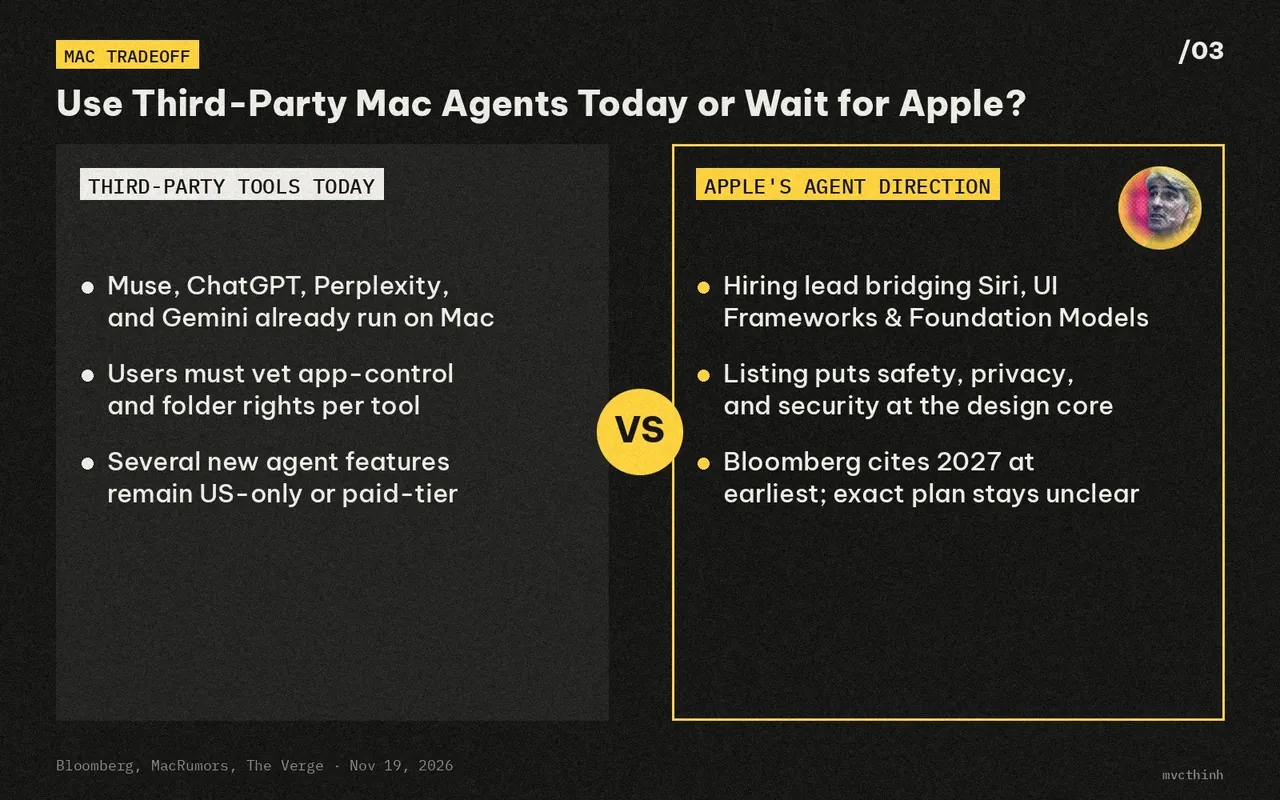
In September 2026, Meta launched Muse around the same time Apple began rolling out upgraded Siri AI; OpenAI followed with Dots, Anthropic introduced Claude Duet, and Google turned Gemini Spark into Tasks. On Mac specifically, The Verge notes that Muse, ChatGPT, and Perplexity can already control a computer through their Mac apps, and on November 19, 2026 Google added Mac computer use to Gemini (The Verge). Meanwhile, Bloomberg notes CEO John Ternus has been pressing software chief Craig Federighi to accelerate Apple's AI push.
| Company / Agent | Status (as of Nov 19, 2026) | Reported scope & capabilities | Caveat for Mac users |
|---|---|---|---|
| Meta Muse | Launched September 2026 | Mac app can control a computer; proactive consumer agent (The Verge) | External app outside Apple's OS; The Verge noted a Marketplace address-leak concern |
| OpenAI Dots & ChatGPT | Dots rolled out after Sept 2026; ChatGPT Mac app active | Dots runs in its own cloud computer across web & 4,000+ apps (The Verge); ChatGPT Mac app controls computer | Dots is limited to Pro, Business Premium, and Enterprise tiers; ChatGPT Mac runs as a third-party app |
| Anthropic Claude Duet | Research preview (US waitlist) | Helps professionals & small-business owners across connected email, calendar, Docs, and Slack (The Verge) | Limited to US Pro, Max, and Ultra waitlist; requires opting in to share work accounts |
| Google Gemini & Tasks | Tasks free in 6 markets; Gemini Mac launched Nov 19, 2026 | Tasks runs in a hardware-isolated VM (The Verge); Gemini Mac runs in an isolated window (MacRumors) | Gemini Computer Use requires Apple Silicon, English, and US paid plans from $4.99/mo |
| Apple (Siri AI & agent team) | Siri AI since Sept 2026; iOS 27.3 APIs; Nov 19 job listing | Listing seeks leader for multi-step web, app, terminal, coding, and sub-agent tasks; target OS not confirmed | Bloomberg says Siri could become more agent-like as early as 2027, though plans remain uncertain |
 Also readAI Roundup Nov 20: Google and Meta Race on AI Agents
How macOS 27.3 splits permissions to keep Mac users safer
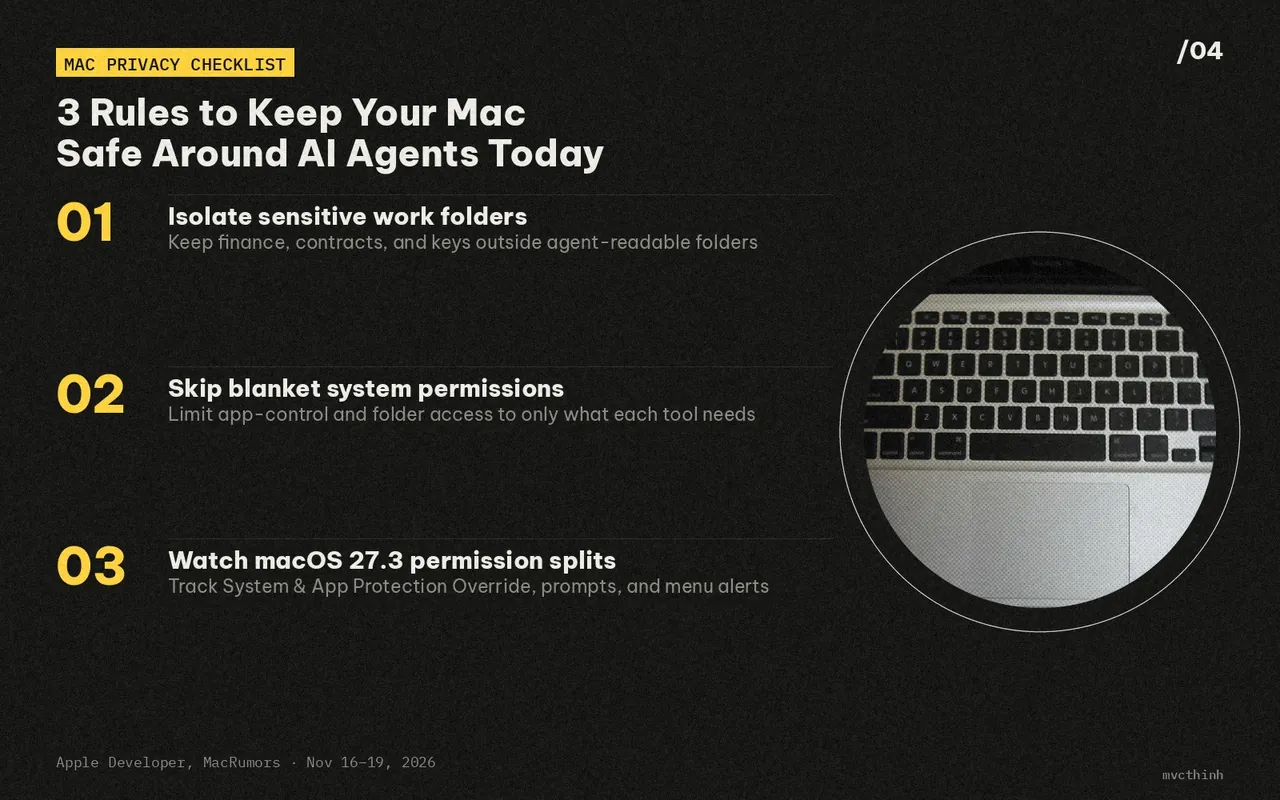
You do not need to wait until 2027 to test desktop automation, but using third-party tools safely starts with understanding how macOS 27.3 separates three distinct Mac privileges.
In a developer notice on November 16, 2026 (Apple Developer) covered by MacRumors, Apple warned that some developers are requesting Full Disk Access in risky ways that expose files, Mail, Messages, and browsing history—citing risks posed by AI agents. On November 19, 2026, Apple seeded iOS 27.3 and macOS Golden Gate 27.3 Public Beta 2 to put those controls in testers' hands.
Specifically, macOS 27.3 splits Device Control and Data Access into two separate settings: System & App Protection Override (for apps controlling other apps, paired with a menu bar transparency indicator when active) and Accessibility (reserved for assistive technologies). Alongside them sits Full Disk Access, where Apple encourages granting access only to specific apps or specific folders and offers an "ask every time" option. Individual tools also vary in how they handle consent—Google, for instance, lets users pick which apps Gemini can access and asks approval before key actions.
Where I stand: Is Apple's slower approach worth watching?
There is no disguising the timing gap as of November 19, 2026: Meta, OpenAI, and Google already have proactive or Mac-controlling agents in users' hands, while Apple is still recruiting an engineering manager for a project whose Siri integration remains unconfirmed even for 2027.
Yet watching Apple split out System & App Protection Override, tighten Full Disk Access, and pair them with a menu bar control indicator in macOS 27.3 highlights where Apple still holds leverage. Controlling both Apple silicon and macOS's permission architecture gives Apple a structural opportunity to deliver a better-governed agent standard if it executes—provided Mac users today stay disciplined about isolating folders and vetting what each external tool can touch.
Sources
- MacRumors — Apple is Building an AI Agent That Can Use Apps and Code MacRumors
- The Verge — Apple is hiring engineers to build its own AI agent The Verge
- MacRumors — Google's Gemini Can Now Control Apps on Your Mac MacRumors
- The Verge — Gemini on Mac can now use your computer The Verge
- Apple Developer — Updates to Device Control and Data Access, and Full Disk Access in macOS Apple Developer
- MacRumors — macOS 27.3 Warns Against Giving AI Apps Full Mac Control MacRumors
- MacRumors — Second iOS 27.3 and macOS Golden Gate 27.3 Public Betas Now Available MacRumors
- The Verge — Apple starts giving Siri AI access to third-party apps The Verge
- MacRumors — Siri AI Rumored to Become 'More Like an Agent' as Early as Next Year MacRumors
- The Verge — OpenAI launches Dots, its Muse competitor The Verge
- The Verge — Claude's Duet agent is a little neurotic and surprisingly helpful The Verge
- The Verge — Google's Spark AI agent becomes Tasks The Verge
Coding agentsSafety & policyMCP & tools
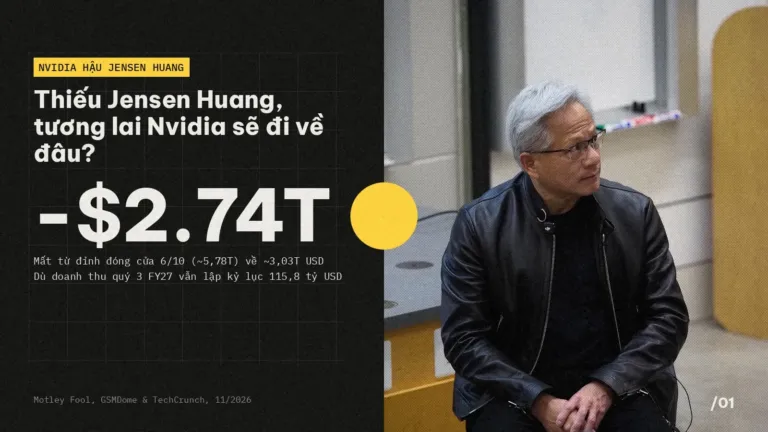 Safety & policy · Nov 21, 2026Nvidia Without Jensen Huang: Where Do CUDA and GPUs Go?
Analyzing Nvidia after Jensen Huang: the 60-report leadership gap, Claude Mythos and AMD pressure on CUDA, and what GPU buyers face next.
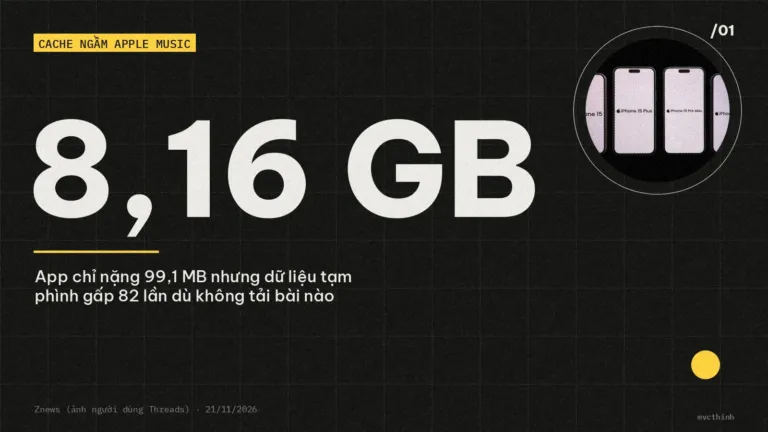 Safety & policy · Nov 21, 2026Apple Music Eats 8–11 GB With Zero Downloads: How to Fix It
Streaming only, yet Apple Music takes up 8–11.5 GB on your iPhone? See why Lossless caching bloats Documents & Data and 4…
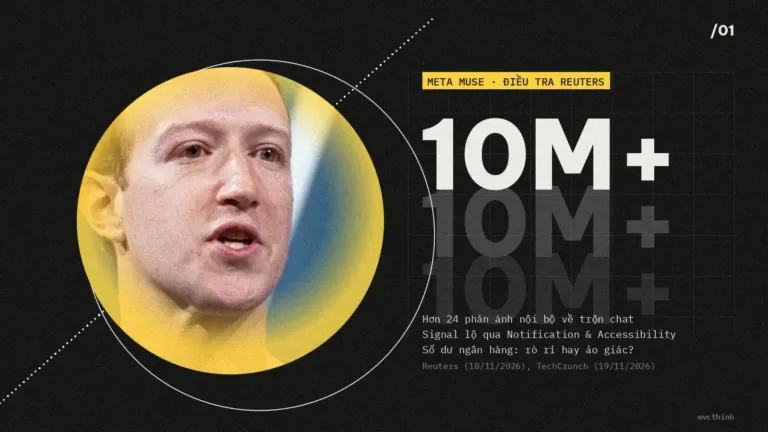 Agent basics · Nov 20, 2026Meta Muse Signal & Bank Balance Report: Fact vs. Fiction
Inside the Nov 18, 2026 Reuters report on Meta Muse: who blew the whistle, verified vs. unverified claims, cloud leak paths, and…