Blog · AI Agent News · Safety & policy VIEN
SpaceX Gets 1M AI Satellites Approved, but AI Won't Get Cheaper
The US cleared SpaceX for 1 million AI satellites, yet orbital servers still cost nearly 3x ground ones. Here is what it means for your AI bill.
In this article
If you pay for AI every month, news that the US has let SpaceX launch up to 1 million satellites to carry AI servers in orbit, powered by sunlight, sounds like good news: sunlight is free, so AI should get cheaper. The numbers point the other way. According to a space engineer's calculation, a cluster of servers in orbit costs nearly 3x as much as a cluster of the same size on the ground. That is why I read this permit as giving big tech companies more room to put servers, not as something that lowers what you pay for AI.
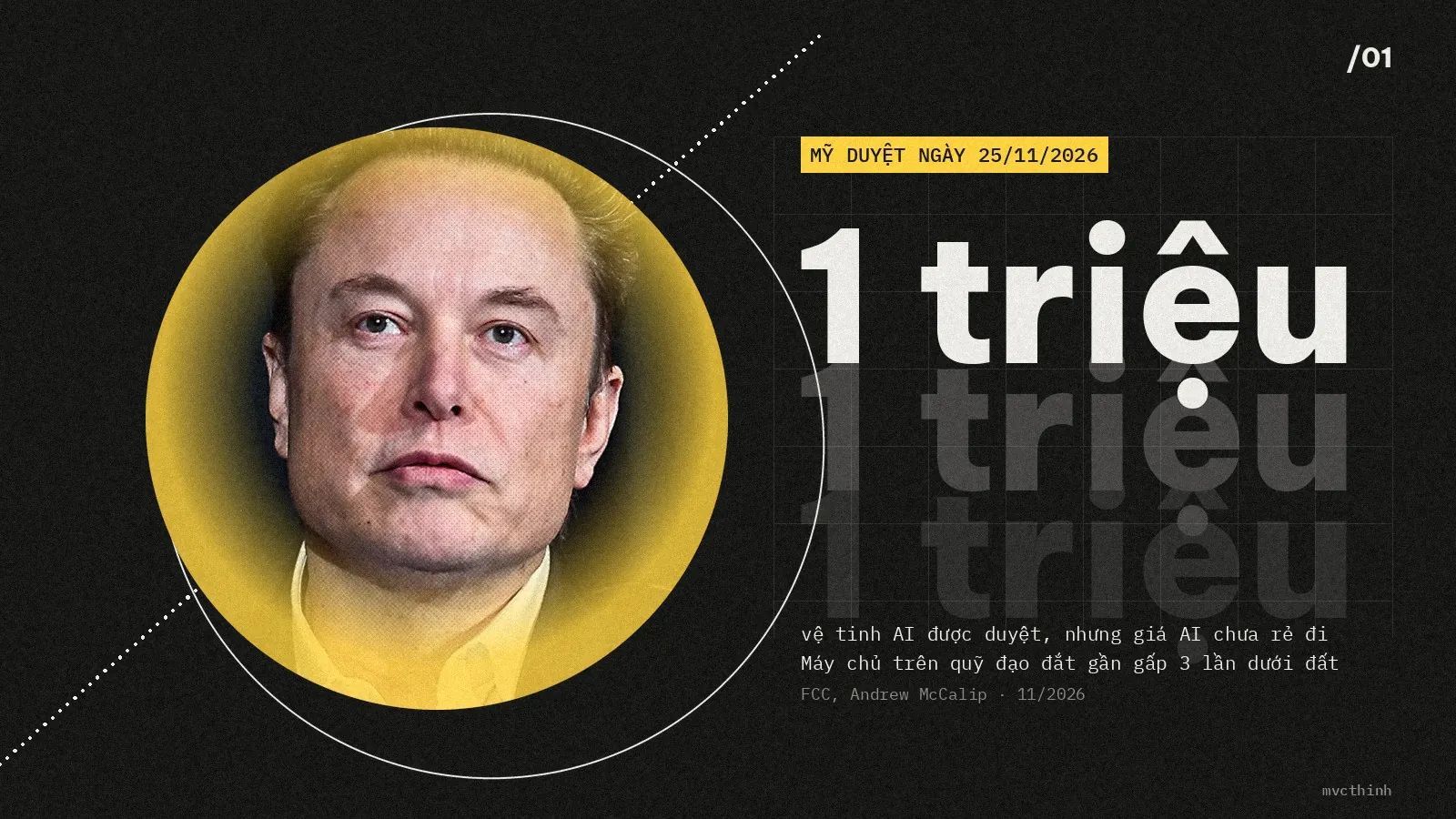
On November 25, 2026, the Federal Communications Commission (FCC) gave SpaceX conditional approval for Starmind, a network of up to 1 million satellites. The whole network is called an orbital data center: instead of the warehouses full of servers that run your AI apps on the ground today, the servers are mounted on satellites circling the Earth. SpaceX has until November 2033 to get the first satellite working and until 2040 to finish, so the AI bill you pay over the next few years will still be set by servers on the ground.
For users, servers in orbit do not make AI cheaper
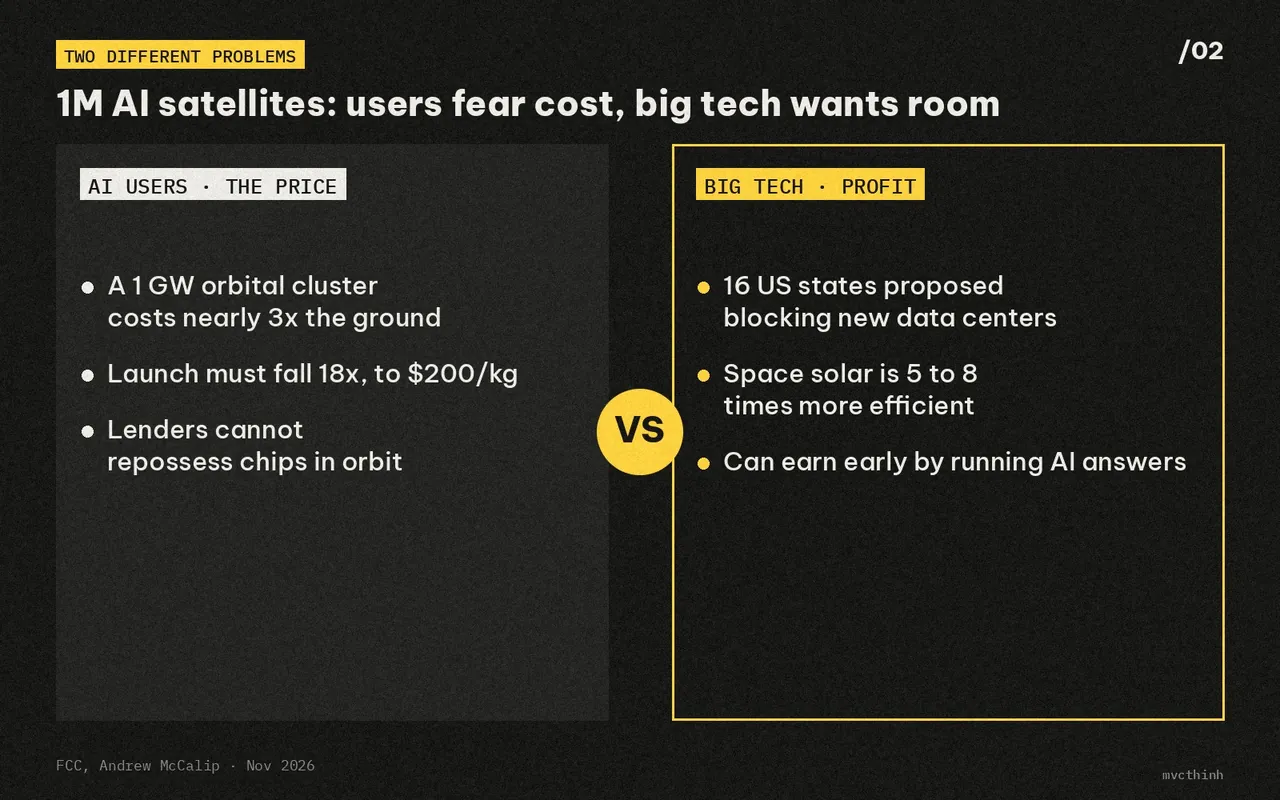
Andrew McCalip, a space engineer, built a calculator for the cost of these servers. His result is that an orbital data center with 1 GW of power, about the size of a large power plant, might cost around $42.4 billion. That is almost 3x a comparable ground site, because satellites must be built and then launched. An operator that spends far more up front has little room to cut rental prices early.
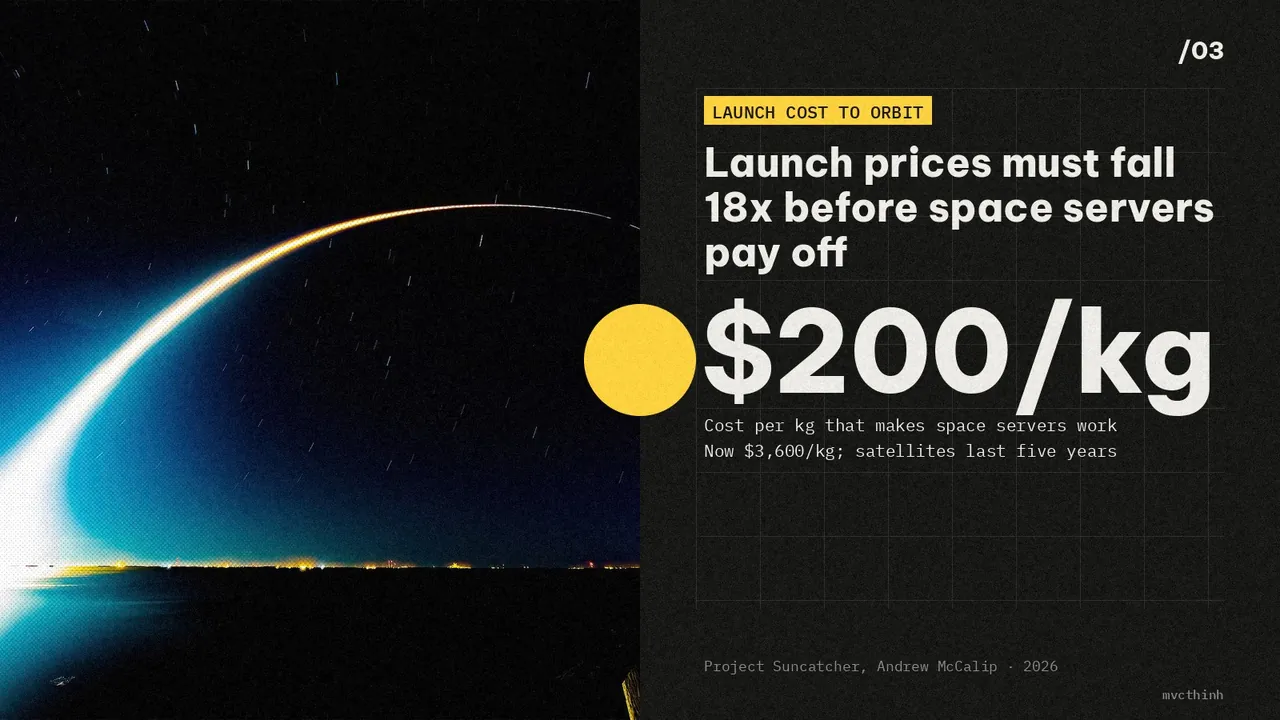
Launch cost is the heaviest part. A reusable Falcon 9 delivers cargo to orbit for roughly $3,600 per kilogram today. According to the white paper behind Google's Project Suncatcher, space servers become workable only near $200 per kilogram, an 18-fold drop that the project expects in the 2030s. Even if new rockets are cheaper, economists at the consultancy Rational Futures argue that SpaceX will not want to charge much less than its best competitor, since that would leave money on the table.
Borrowing is the second obstacle. When companies build data centers on the ground, they often borrow by pledging the AI chips they just bought as collateral, much like taking a bank loan to buy a car and using the car as security. If the company cannot repay, the lender can take the chips back. But chips mounted on a satellite roughly 300 miles up cannot be repossessed. So the lenders in SpaceX's chip financing deal asked that none of those chips be used for its orbital data center plans, although it is not clear whether SpaceX agreed to that condition.
On top of that, silicon solar panels in space wear out faster because of radiation, which limits the lifetime of AI satellites to about five years. Equipment that lasts only a few years forces the operator to earn its money back faster from every customer, and that pressure will show up in rental prices.
| Comparison | Ground data center | Orbital data center |
|---|---|---|
| Cost of a 1 GW cluster | The benchmark | About $42.4 billion, nearly 3x |
| Getting cargo to orbit | No launch needed | Must fall 18x, from $3,600 to $200 per kilogram |
| Borrowing to buy chips | Chips serve as collateral | Lenders cannot repossess, so they asked not to use them |
For big tech companies, orbit is a new place for servers and a new source of profit
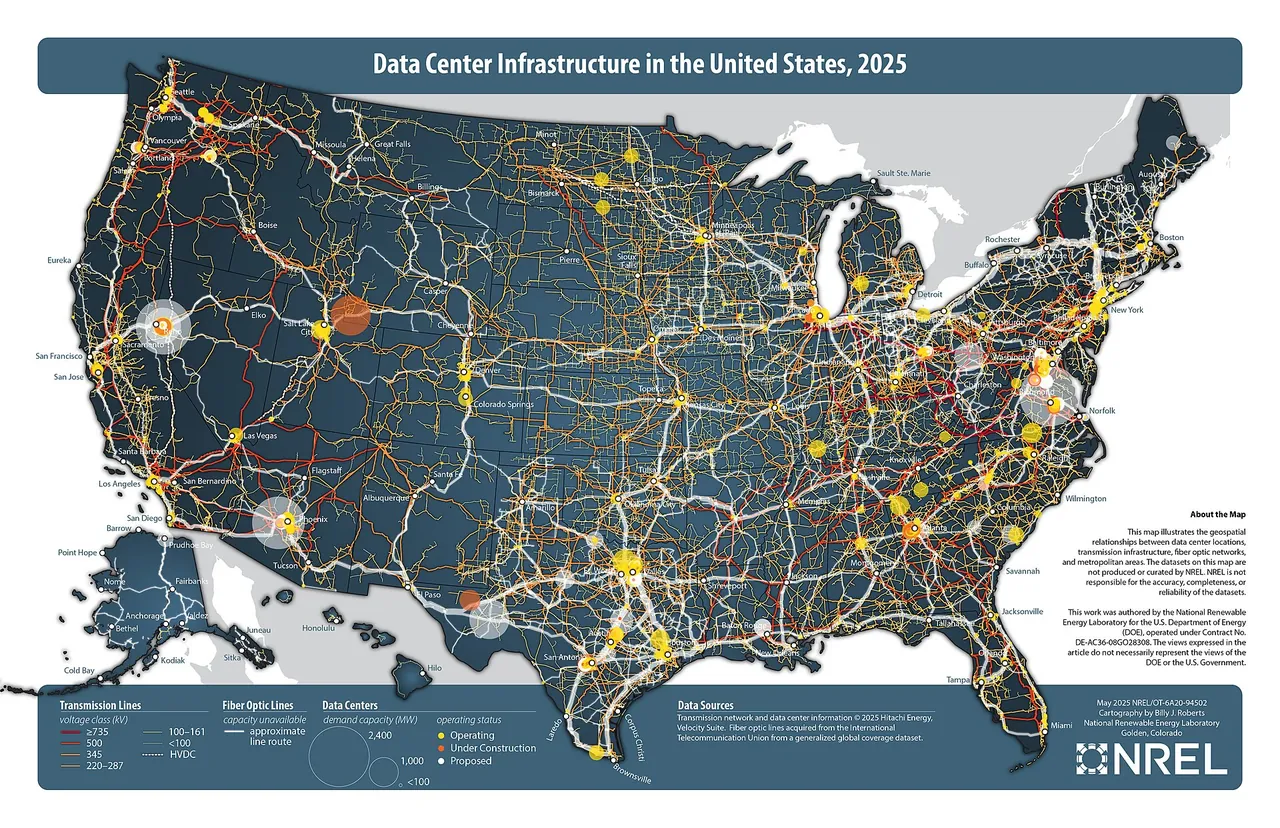
Big companies accept high costs because they face a different limit: room for servers on the ground is shrinking. Data centers need large sites, consume a lot of power and water, and people living nearby increasingly do not want them. In the US, 16 states have proposed laws to ban or temporarily block new data centers.
When customers want more AI capacity and a company cannot build more servers, its revenue stalls. McCalip says a company with both rockets and an AI business, like SpaceX, can keep scaling on the ground until it hits permitting or capital limits, then shift the rest to space.
Electricity is the second benefit. Solar panels in space are 5 to 8 times more efficient than on Earth, and in the right orbit they sit in sunlight for most of the day. SpaceX owns its rockets, so it launches its own satellites, and Starmind satellites will communicate mainly by laser with other satellites, including the existing Starlink network. Google has already launched a test AI server satellite under Project Suncatcher and booked Blue Origin for its first dedicated heavy-lift launch in 2029. Google is also focused on putting its own chips in orbit, which may be an advantage because it has less to worry about lenders blocking chips.
These companies also do not have to wait until they can train giant AI models in space to earn money. Training a model on data takes thousands of chips working in step, and the fastest laser links between satellites today fall short. The easier job is inference: using a model that is already trained to give answers, like each time you type a question into a chat app. Inference needs only dozens of chips, which can fit on one satellite. Philip Johnston, CEO of the startup Starcloud, says the company's first AI satellite is already earning revenue running inference in orbit, which means this business has paying customers, even if only at small scale.
 Also readViettel's Starlink from 9.3M dong; 400 Mbps is the vendor's claim
Users should budget for AI at ground-based prices
The November 25 permit solves a room-for-servers and profit problem for big companies, while the price you pay for AI over the coming years is still set by ground infrastructure. As long as an orbital cluster costs nearly 3x as much and lenders stay wary of chips sent into space, expecting chat plans or API prices to fall because of satellites has little basis. Even the figure of 1 million satellites may not happen, since it is unclear whether SpaceX will launch that many or simply asked for more than it will use.
| What to watch | Today | What must happen |
|---|---|---|
| Launch price per kilogram | About $3,600 | Close to $200 |
| Cost of a 1 GW cluster in orbit | About $42.4 billion | Falls close to the ground level |
So write your AI budget at today's prices and do not count on any discount from satellites. At the same time, go through your repeated daily tasks and see which are light enough to run on the computer or phone you already use, because some people predict that more AI processing will run on hardware already inside those devices, reducing the need for huge data centers. To know when big tech's advantage might reach your wallet, watch the two numbers in the table above; only when both get close to the level they need is there a real basis for lower AI rental prices.
SpaceX now has a permit to build a new way of making money beyond Earth, but launch costs, chip financing and satellite lifespan have not yet shown any savings that will reach users.
Sources
- US approves SpaceX plan to send a million data satellites to space BBC News
- FCC approves SpaceX plan to put AI data centers in space TechCrunch
- Why the economics of orbital AI are so brutal TechCrunch
- Chips can survive the space environment — can their financing? TechCrunch
- FCC signs off on SpaceX’s plan to put up to 1 million data center satellites into space The Verge
- Big, noisy and coming to a town near you - why the data centre backlash is growing BBC News
 Automation · Nov 27, 2026WD 20 TB External Drive Hits $549.99, 2.2 Times the 2024 Price
Best Buy now sells the WD EasyStore 20 TB at $549.99, up from $249.99. Video editors should price storage per project before…
 Safety & policy · Nov 27, 2026Nvidia halts 4 SEA hubs: Vietnam hosts see an opening, startups pay
Nvidia's server freeze in four neighboring hubs gives Vietnamese hosts an opening while squeezing cheap cloud GPUs, pushing startups toward local hardware.
 OpenAI & ChatGPT · Nov 27, 2026GPT-6.2 Astra hits limits 40% faster, shaking monthly quotas
OpenAI patched a GPT-6.2 billing bug on Nov 26, 2026, making Plus, Pro, and Business users hit limits 40% faster and rethink…