Blog · AI Agent News · Automation VIEN
Viettel's Starlink from 9.3M dong; 400 Mbps is the vendor's claim
Viettel sells Starlink from Nov 26, kit from 9.3M dong. We compare U.S. pricing, map 174 markets, and explain why Vietnam speeds top the U.S. by 2.8x.
In this article
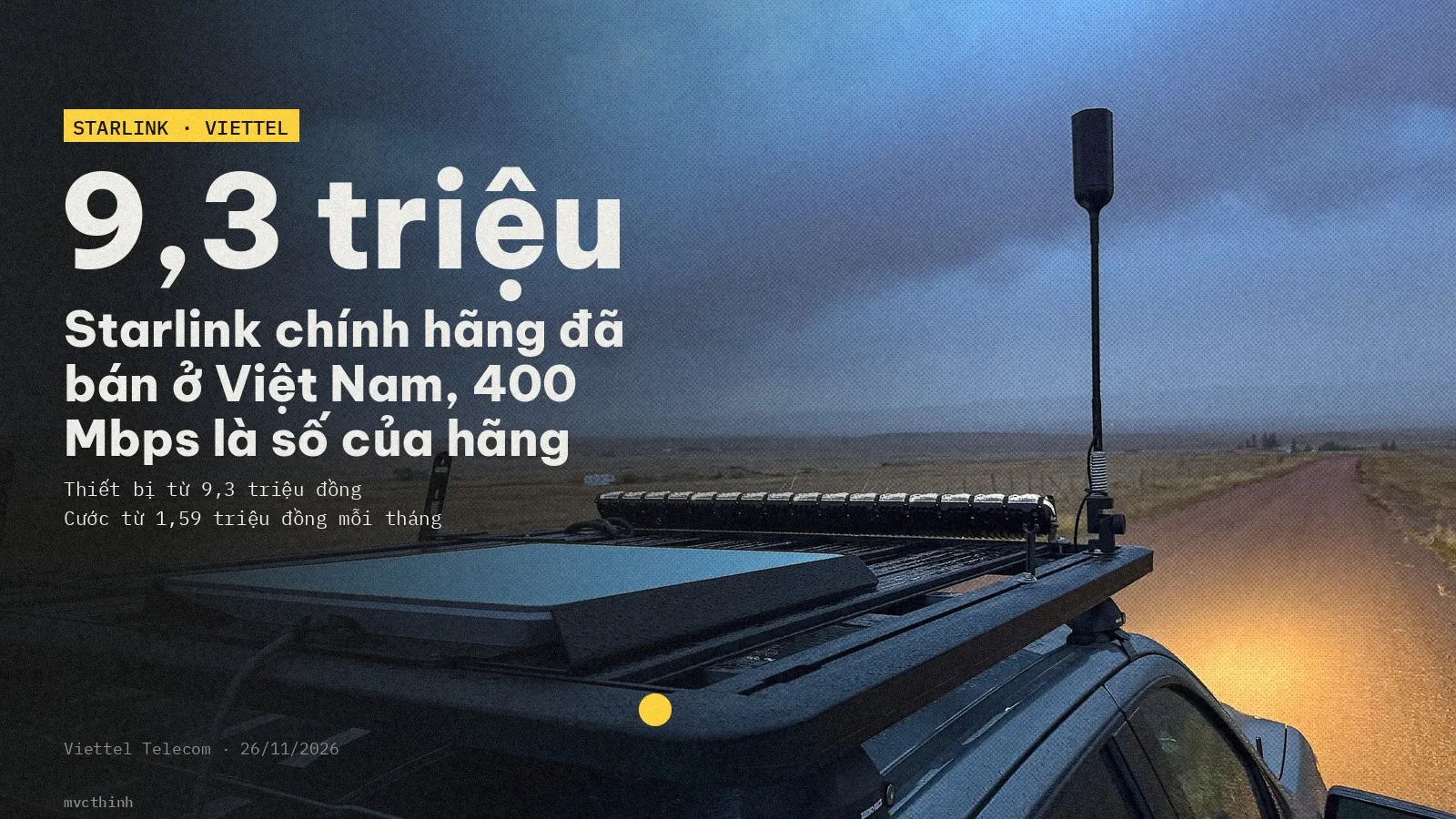
Picture yourself filming on an island with no fiber, sending clips to a client every night while the phone signal comes and goes. Since November 26, 2026, Viettel Telecom officially offers Starlink satellite internet in Vietnam with an introductory kit price from 9.3 million dong and plans from 1.59 million dong a month. Earlier, on November 16, 2026, Viettel Group received a nationwide non-facilities-based telecom license from the Hanoi Department of Science and Technology, followed by sales training across 34 provinces and cities on November 20, 2026, as documented on Viettel Telecom's Tendoo portal.
Because the system uses low-Earth-orbit satellites — satellites flying much closer to the ground than traditional ones so signals travel back and forth faster — it requires no cable run to your address, only a dedicated terminal. Viettel supplies official hardware with local warranty and technical support in Vietnam. My view: it is worth buying for people with no ground broadband or regular trips at sea, while people who already have fiber at home should not rush in, because 400 Mbps remains a vendor figure for favorable conditions.
Upfront cost starts at 10.89M dong, close to U.S. prices but far above local fiber
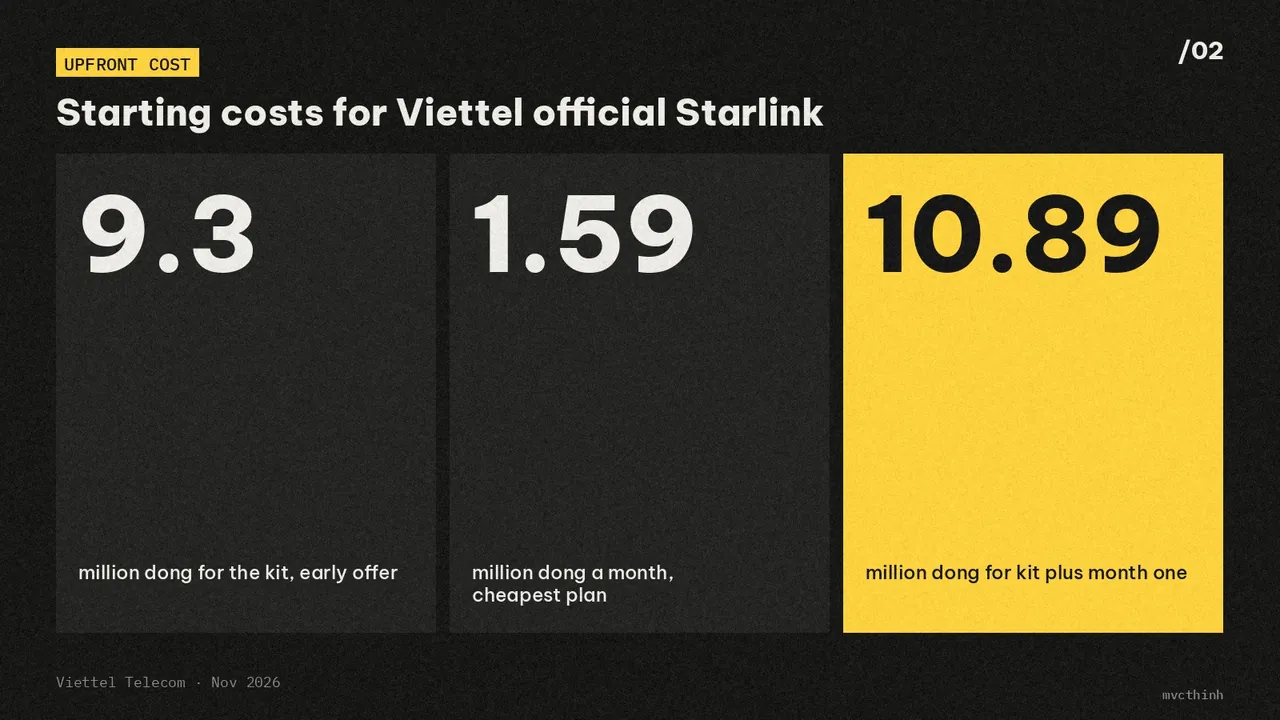
The kit carries an introductory price from 9.3 million dong and service starts at 1.59 million dong a month, putting hardware plus month one at 10.89 million dong. The word "from" marks the launch floor: if both minimums hold for a full year, year one costs about 28.4 million dong (9.3 million plus 12 months at 1.59 million), my own arithmetic rather than a Viettel bundle.
Viettel sells 3 hardware lines (Mini, Standard, and Performance Gen 3) and two plan families. Local plans cover mainland Vietnam and coastal waters inside the service area; Global plans cover offshore vessels or international travel where Starlink operates. If you work in the mountains or on coastal islands, Local is the group you need.
| Channel and tier | Hardware price | Monthly service | Key scope |
|---|---|---|---|
| Viettel Telecom (starting offer) | From 9.3M dong | From 1.59M dong | Local warranty and support in Vietnam |
| Viettel Local Priority (business) | 9.6M – 55.4M dong | 1.8M – 22.3M dong | 50 GB to 3 TB high-speed data, VAT included |
| Starlink direct in Vietnam | 8,655,300 – 10,269,900 dong | 1,131,990 – 1,711,100 dong | 100 Mbps and Max plans, self-setup |
| Starlink in the U.S. (20% dynamic) | Around 340 USD (Standard) | 44 – 156 USD | 55, 85, and 130 USD midpoints by congestion |
On Viettel Ho Chi Minh City's enterprise consultation site, Local Priority tiers (including 10% VAT) run from 1.8 million dong a month for 50 GB up to 22.3 million dong for 3 TB; hardware (including 8% VAT) costs 9.6 million dong for Mini, 11.2 million dong for Standard, and 55.4 million dong for Performance Gen 3. Meanwhile, buying directly from Starlink in Vietnam offers two residential plans at 1,131,990 dong a month (capped at 100 Mbps) and 1,711,100 dong a month (Max), paired with the Mini kit at 8,655,300 dong or Standard 4X at 10,269,900 dong.
Compared with the U.S. market reported by Notebookcheck, Starlink now applies dynamic pricing swinging roughly 20% around midpoints based on local demand: 100 Mbps runs 44 to 66 USD (55 USD midpoint), 200 Mbps runs 68 to 102 USD (85 USD midpoint), and Max runs 104 to 156 USD (130 USD midpoint), with the Standard kit around 340 USD on Amazon. Vietnam pricing therefore tracks global levels closely rather than carrying a heavy markup. The real gap is domestic: with fixed broadband starting at 195,000 dong a month, Starlink's direct plans cost 5.8 to 8.8 times more, while 4G covers 99.8% of the population and over 87% of Vietnamese households already have fiber.
174 global markets covered, yet only 633 subscribers in Vietnam
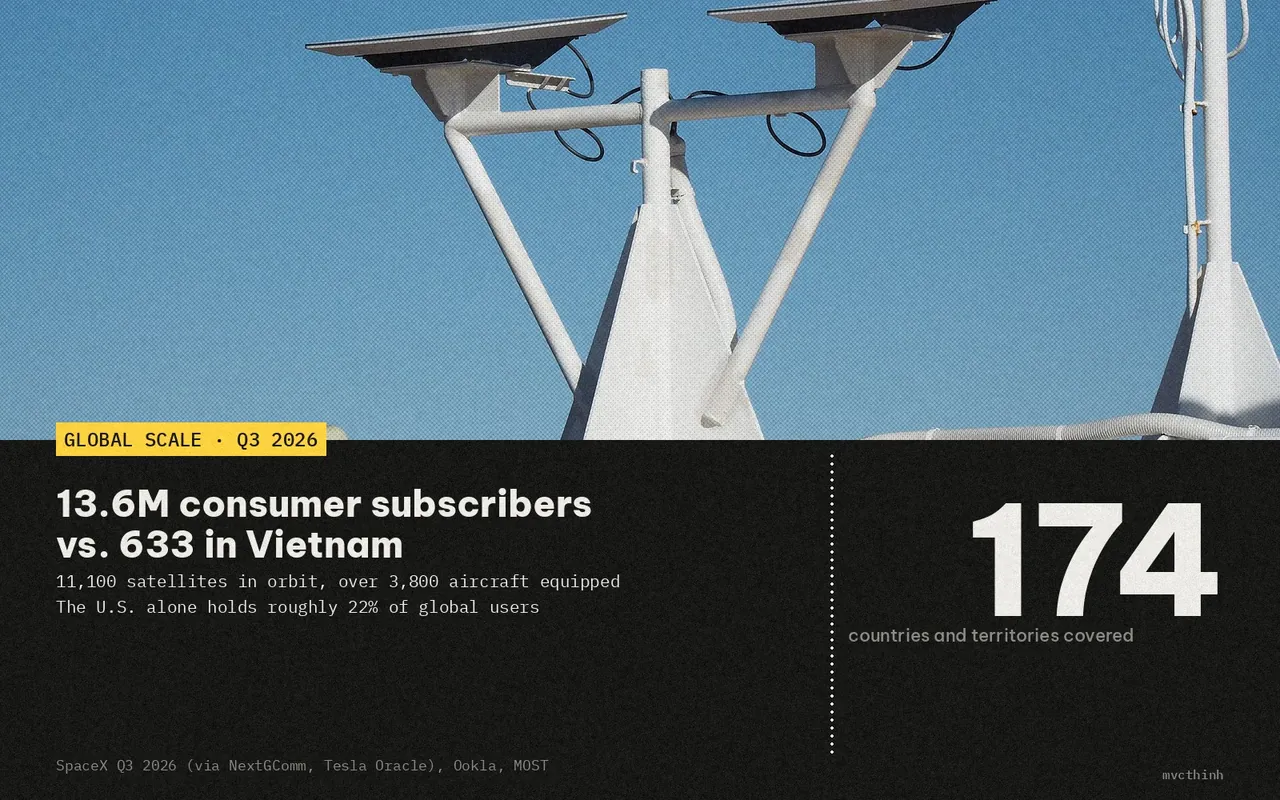
According to SpaceX's Q3 2026 financial summary reported by NextGComm and Tesla Oracle, by the end of September 2026 Starlink served 174 countries and territories with 11,100 satellites in orbit. Consumer subscribers reached 13.6 million — up 1.6 million in a single quarter from 12 million in Q2 — averaging 69 USD in monthly consumer revenue per user, alongside more than 3,800 equipped aircraft.
The U.S. alone is Starlink's largest market, accounting for roughly 22% of global customers in Ookla's data. By contrast, Ministry of Science and Technology figures cited by VnExpress show just 633 active subscribers in Vietnam after three months of direct availability, including 196 connectivity-gap sites across 154 villages and 42 public facilities.
 Also readGemini 4 Neon: Medium Costs 8× Less Than Claude, Scores Higher
Vietnam hits 338.9 Mbps vs. 119.71 Mbps in the U.S.: a 2.8x gap driven by user density
Mbps measures link throughput: bigger numbers transfer photos and clips faster. Latency is signal round-trip time: lower numbers keep calls and games smooth. Viettel quotes download speeds over 400 Mbps and 20 to 50 ms latency under suitable conditions, while its Local Priority sheet lists roughly 400 Mbps down and 40 Mbps up.
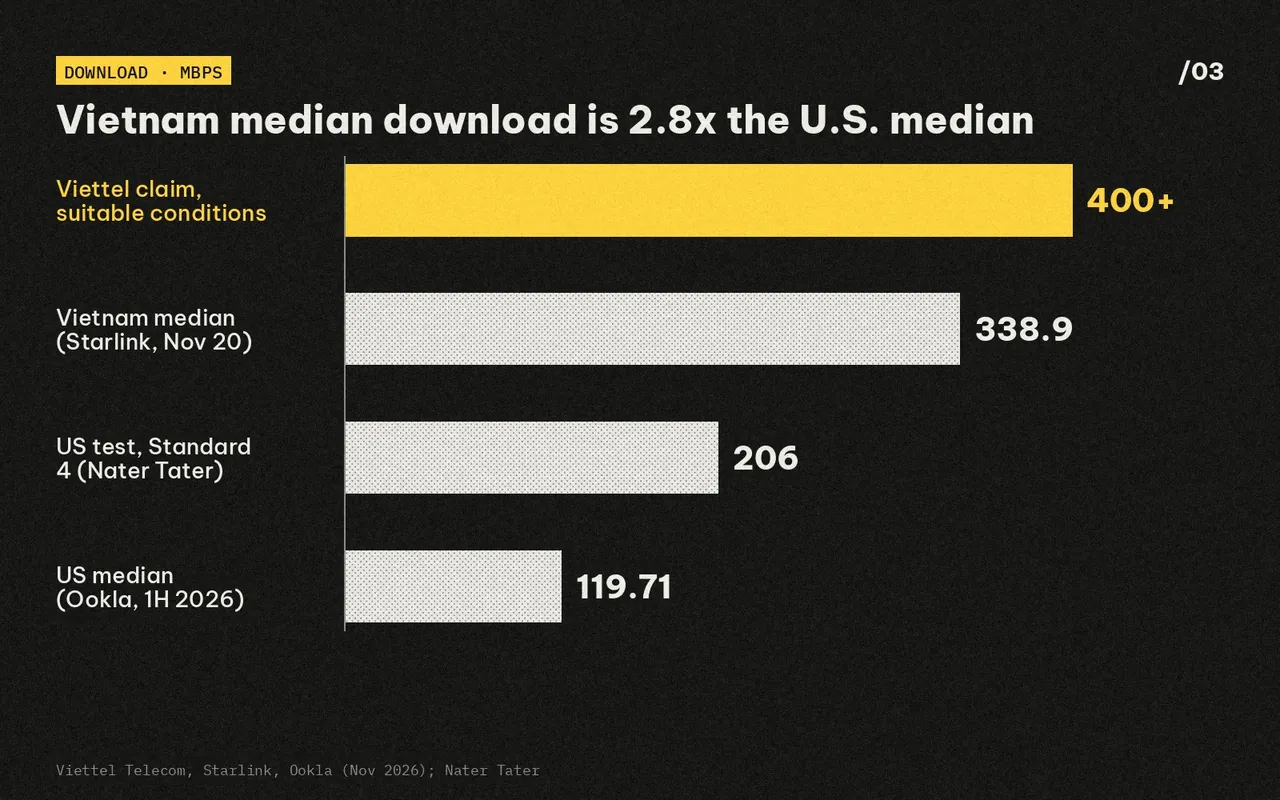
Real-world telemetry shows a stark divide between the two countries. Because Starlink only launched in Vietnam in August 2026, Ookla has no Vietnam median yet, but Starlink's public availability data updated November 20, 2026 records a Vietnam median download of 338.9 Mbps (20th–80th percentile spread of 275.5 to 398.8 Mbps), 46.6 Mbps upload, and 27.5 ms latency — tracking Viettel's guidance closely.
By comparison, Ookla's 1H 2026 U.S. report published November 11, 2026 measured a national median download of just 119.71 Mbps, ranging from Utah at 165 Mbps down to Florida at 89 Mbps. National median upload hit 20.73 Mbps (up 42% year-over-year), and only 24 states plus Washington, D.C. stayed under 40 ms latency. In an independent U.S. test by YouTuber Nater Tater with the Standard 4 kit, Starlink delivered 206 Mbps down — trailing T-Mobile 5G — alongside 18.4 Mbps up and 46 ms ping.
| Metric | Viettel claim (favorable) | Vietnam median (Starlink, Nov 20) | U.S. median (Ookla, 1H 2026) | U.S. Standard 4 test (Nater Tater) |
|---|---|---|---|---|
| Download | Over 400 Mbps | 338.9 Mbps | 119.71 Mbps | 206 Mbps |
| Upload | Around 40 Mbps (Local Priority) | 46.6 Mbps | 20.73 Mbps | 18.4 Mbps |
| Latency (ping) | 20–50 ms | 27.5 ms | Under 40 ms (24 states & D.C.) | 46 ms |
Vietnam's median download therefore runs 2.8 times the U.S. median. The hardware is not faster; the gap comes down to beam sharing. Roughly 22% of Starlink's 13.6 million global subscribers share capacity in the U.S., alongside discounted 100 Mbps plans pulling down the national median. In Vietnam, just 633 users share the sky, leaving early adopters with wide-open lanes.
For creators uploading heavy clips nightly, upload throughput is the number to ask about: Vietnam averages 46.6 Mbps while quiet, whereas crowded U.S. beams average 20.73 Mbps and the Standard 4 test managed only 18.4 Mbps. One test does not represent every place, yet it shows matching home fiber takes much more than headline download speed, and Vietnam's 338.9 Mbps will likely tighten as subscribers grow.
Built for dead zones and life at sea, not replacing fiber
Where fiber or stable 4G and 5G already exists, Starlink does not automatically replace terrestrial networks given its higher monthly bill and shared upload capacity. Before ordering through Viettel, ask three things: whether your location needs Local or Global coverage, what the standard rate is after the introductory offer, and what upload speed your chosen tier delivers.
In the U.S. test, 5G beat Starlink on download speed while Starlink led only on latency. Treat it as a backup link when your main line fails, especially in locations terrestrial networks cannot reach.
For anyone heading out to sea, it will be indispensable for staying connected to shore once you cross beyond cellular coverage.
Sources
- Viettel chính thức cung cấp dịch vụ internet vệ tinh Starlink tại Việt Nam Viettel Telecom
- Viettel Telecom phối hợp cùng Starlink tổ chức đào tạo, thúc đẩy kinh doanh Internet Vệ tinh tại Việt Nam Tendoo (Viettel Telecom)
- Bảng giá gói cước & thiết bị Starlink doanh nghiệp Starlink by Viettel
- Viettel bắt đầu cung cấp Internet vệ tinh Starlink VnExpress
- Internet vệ tinh Starlink có 633 thuê bao tại Việt Nam VnExpress
- Starlink chính thức có mặt tại Việt Nam, giá từ 1,13 triệu đồng mỗi tháng CafeF
- Starlink’s U.S. Speeds Rise Amid SpaceX IPO Ookla
- Starlink intros dynamic prices of up to $156 a month Notebookcheck
- Starlink Availability & Speed Map (JSON, cập nhật 20/11/2026) DishyCentral / Starlink
- SpaceX Starlink Q3 2026 Results Connectivity Briefing NextGComm
- Key takeaways from SpaceX Q3 2026 Earnings Call Tesla Oracle
- Viettel cung cấp internet vệ tinh Starlink tại Việt Nam Thanh Niên
- Nhà mạng Việt cung cấp Internet vệ tinh Starlink Dân trí
- Chọn Starlink hay internet 5G để tiết kiệm chi phí? Thanh Niên
 Safety & policy · Nov 26, 2026AI-designed Frostbite CPU claims 4.59x efficiency, but no chip exists
Architect Labs says its AI designed the Frostbite CPU with 4.59x the efficiency, but only in simulation. Here is how the number…
 Claude & Anthropic · Nov 26, 2026Claude Artifacts can now be installed as apps, free plan works
Anthropic lets you install Claude Artifacts as Mac and Windows apps in beta, and a free account is enough. Here is who…
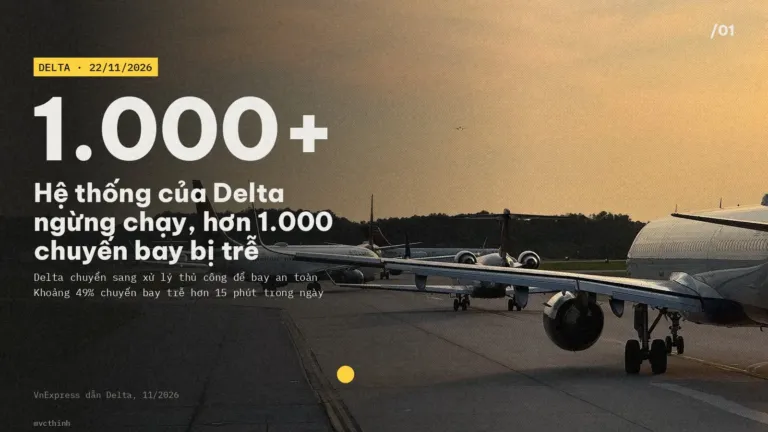 Agent basics · Nov 23, 2026Delta Outage: Over 1,000 Flights Ran Late Even With Manual Backup
Delta switched to manual work, so flights stayed safe, yet nearly half still ran late. If you hand work to AI agents,…