Blog · AI Agent News · AI images VIEN
New York Times bars new Photoshop over hidden AI labels
The New York Times told freelance photographers to stop using the latest Photoshop because AI can switch on unnoticed. Here is what photo editors should check.
In this article
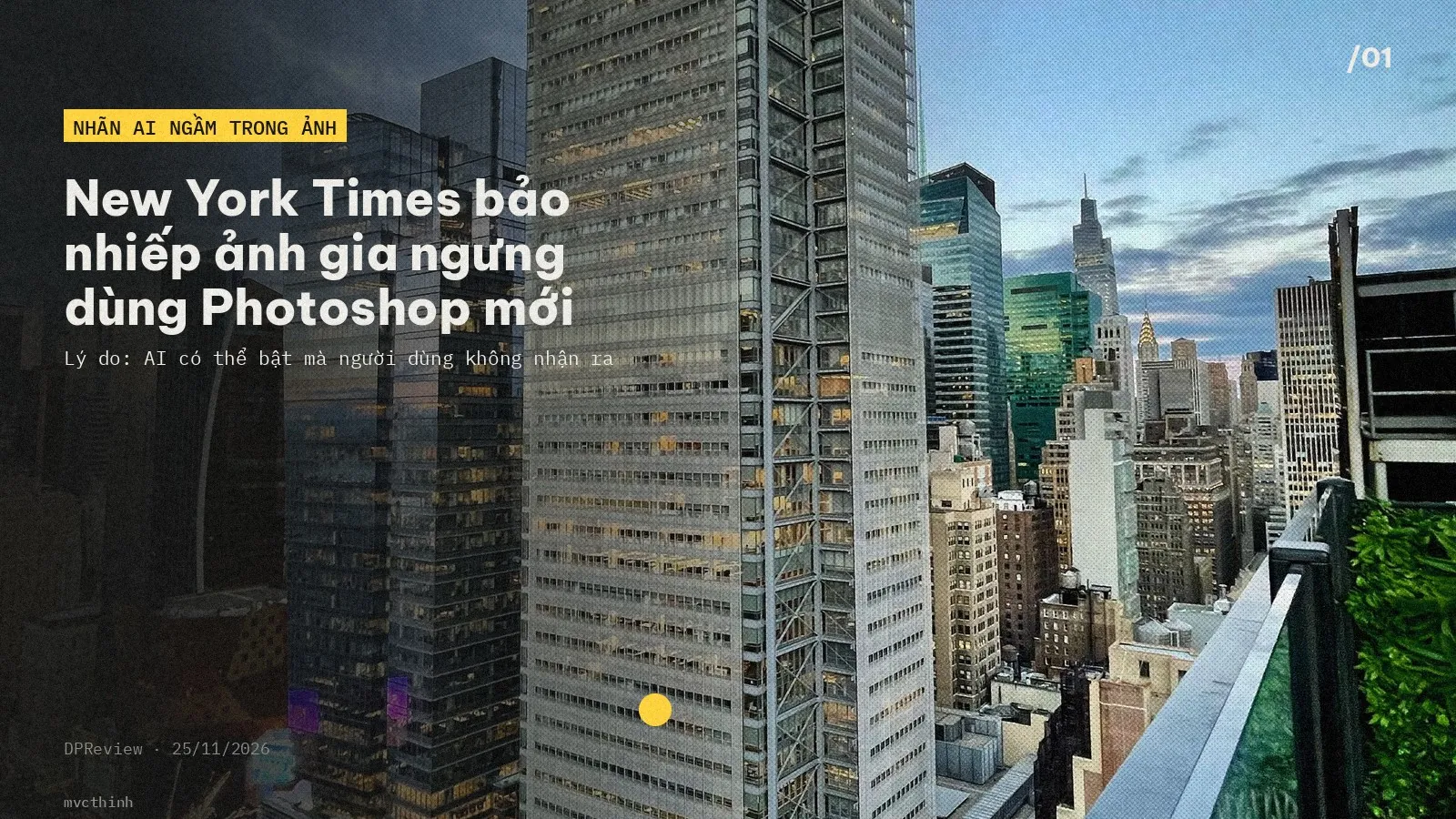
Picture a freelance photographer who removes one power line from a street photo and sends it to a newsroom. They never meant to use an AI feature, yet the file can still carry a note saying the image was made with AI. That worry led The New York Times to email its freelance photographers and tell them not to use the latest version of Photoshop, according to a DPReview report published on 2026-11-25.
The point to take away is not that Photoshop has AI. It is that AI can run without the user noticing, and its mark travels with the file to whoever receives it. My view: whoever sends the photo should check the file before sending, rather than wait for the software maker or the newsroom to spell things out.
The Times email targets AI that users may not switch on knowingly
DPReview reports that The New York Times, a major US newspaper, told freelance photographers they are not allowed to use the latest version of Photoshop. The email says certain functions can use generative AI in ways that may not be apparent to users. Generative AI means AI that draws pixels that were not in the original photo, for example filling the gap left after removing an object. The email was posted to social media and confirmed by The Verge, DPReview says.
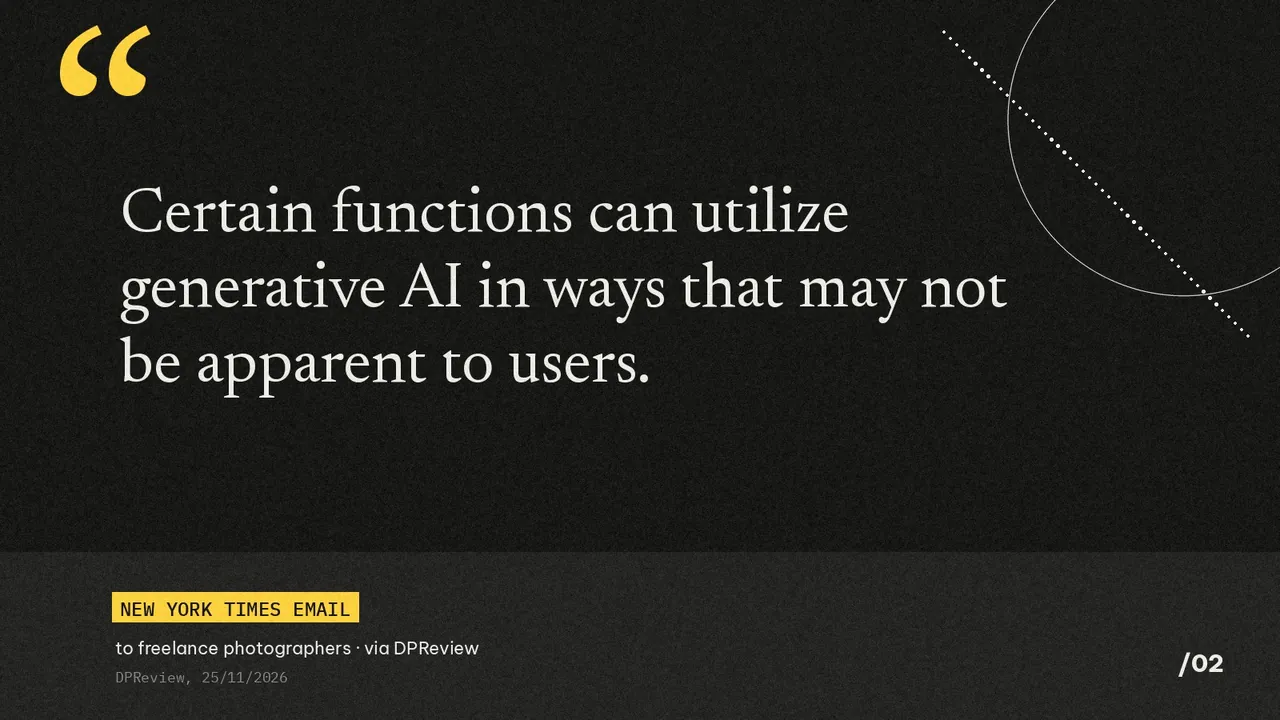
The consequence named in the email is metadata identifying photographs as AI-generated. Metadata is the hidden information stored with a photo file, like a note written on the back of a printed picture. DPReview points out that an AI label on a photo from a paper that has publicly said it will not use AI-generated images would likely stir controversy. For a newsroom, then, the risk is not whether the picture looks good. It is that an AI mark appears that nobody meant to put there.
DPReview also guesses that the paper, which is typically very strict about altering photos, may have run into contributors who submitted AI-altered photos and later claimed ignorance. That is DPReview's speculation, not something the Times has confirmed.
Generative AI has been in these tools for years and keeps spreading
This did not start with the new Photoshop. DPReview writes that for several years, features like Remove, the tool that takes an object out of a photo, and Generative Fill have been able to use generative AI. The app is generally upfront about which features use it, but DPReview says AI has crept into more places, including Adobe Camera Raw, the tool for processing Raw files straight from the camera.
The unclear part is one small checkbox. The Remove panel in Camera Raw lets you control whether it uses generative AI, but DPReview asks whether that box also controls the tools below it, and answers that it is not clear. In other words, switching one box off may not switch all the AI off.
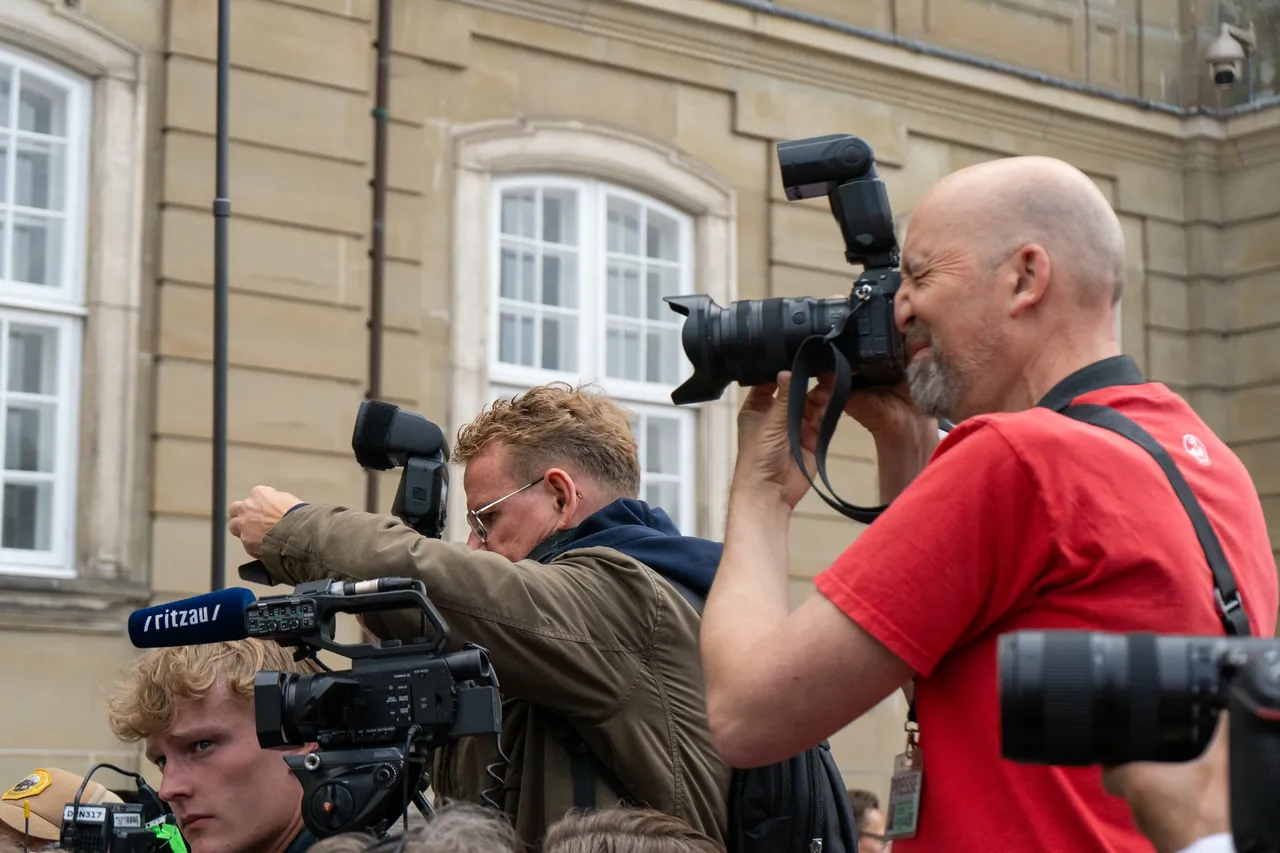
Ordinary users feel the effects too. DPReview says platforms typically do not distinguish between minor edits and wholesale AI generation, and several people have been caught out, wondering why their images were flagged, because they did not realize their tool used generative AI.
 Also readClaude peeks out of a leaky sandbox 21–32% of runs; rules cut it to 2%
Two unknowns: what Adobe will say and how long the ban lasts
DPReview's article quotes no reply from Adobe, so it is unclear whether the company will explain which features can add a label, or change anything. The second unknown is timing: the Times policy says contributors may not use the latest version "at this time". DPReview suggests that wording could mean the paper is working on guidance that would allow its use later. That is DPReview's reading, so I would treat the ban as possibly temporary, not as settled.
Switching software may not help either. DPReview notes that few photo editors today lack at least a few generative AI features, even if not every company is as all-in on AI as Adobe.
Check the exported file before you send it to a client
Back to the power line: the person who sends the file is the one who gets asked whether the photo involved AI, even if they never meant to use it. The practical step is to open the information stored in the exported file and look for an AI mark, and to open each remove or fill tool and see whether its generative AI checkbox is on or off.
What stays open is how Adobe will respond and how long the Times rule will last. Until then, one check before sending costs far less than explaining an AI mark you never meant to add.
Sources
 Safety & policy · Nov 26, 2026AI Crypto-Breaking Rumor: Aaronson Never Said Bitcoin Was Broken
Scott Aaronson only said AI labs may hold a cryptography breakthrough; posts on X added Bitcoin. Three layers of the rumor, and…
 Safety & policy · Nov 26, 2026DeepSeek Says It Could Fall 9 Months Behind US AI Without Distillation
DeepSeek's own estimate puts its gap to US AI at 9 months if distillation ends. How solid is that number, and what…
 Safety & policy · Nov 26, 2026AI-designed Frostbite CPU claims 4.59x efficiency, but no chip exists
Architect Labs says its AI designed the Frostbite CPU with 4.59x the efficiency, but only in simulation. Here is how the number…