Blog · AI Agent News · Safety & policy VIEN
DeepSeek Says It Could Fall 9 Months Behind US AI Without Distillation
DeepSeek's own estimate puts its gap to US AI at 9 months if distillation ends. How solid is that number, and what does it mean for people who run AI at home?
In this article
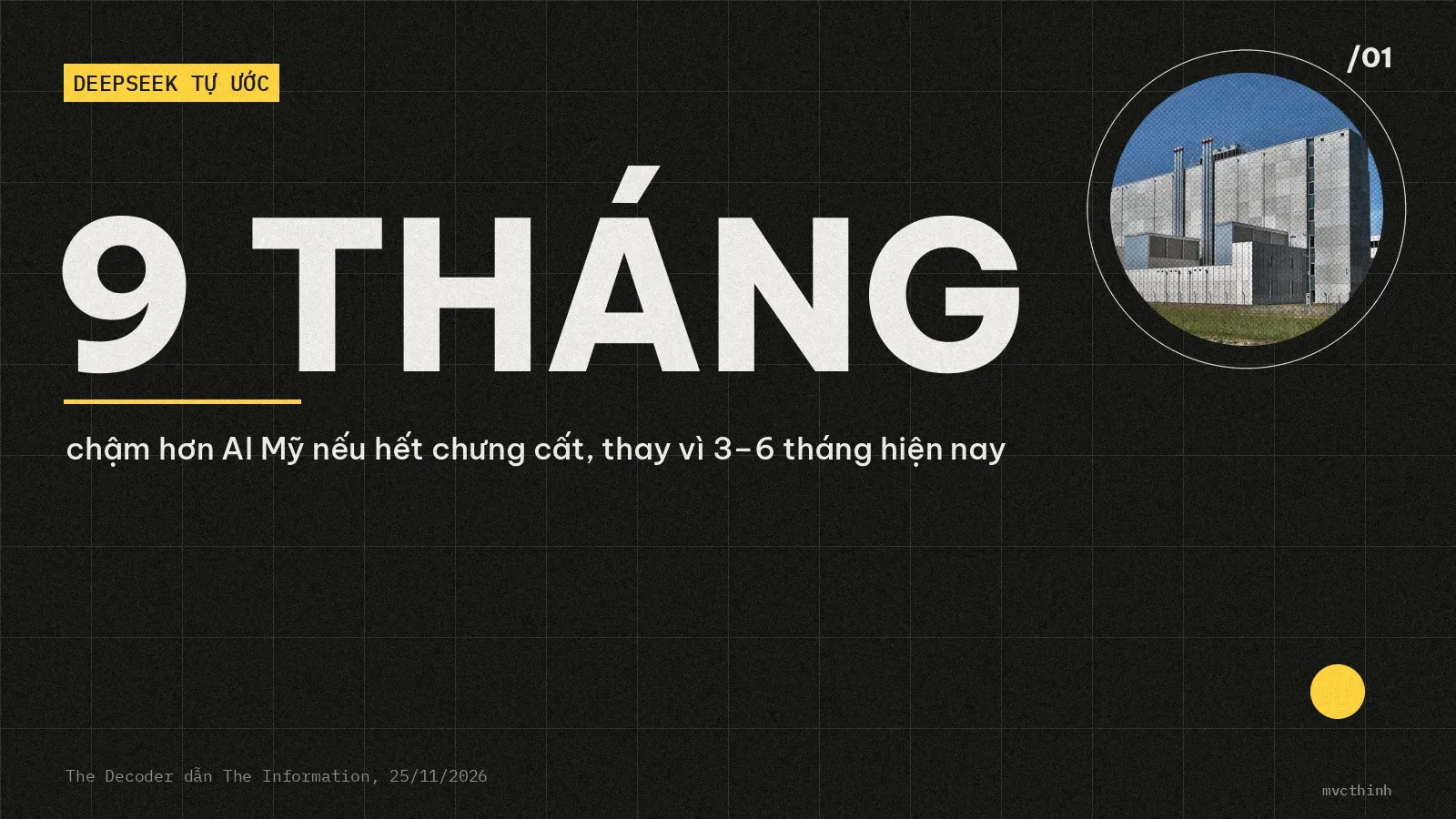
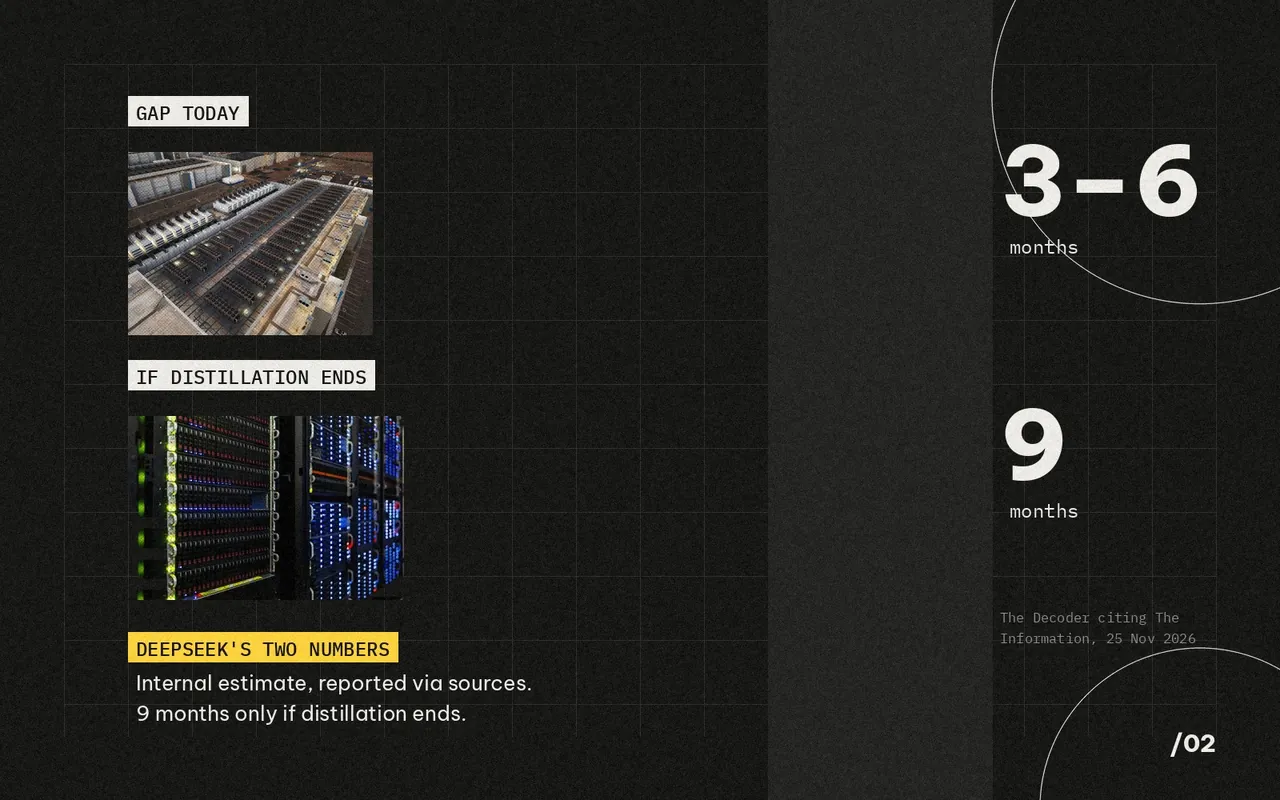
The "9 months" figure sounds like a forecast, but it is really the worst case that DeepSeek's own researchers sketched: if they can no longer learn from US AI models, they would trail the leaders by about 9 months instead of the current 3 to 6. It comes from a report by The Information, relayed by The Decoder on 25 November 2026, and rests on unnamed sources that nobody has independently checked. It matters because it shows two shortcuts used by Chinese labs, renting chips remotely and learning from US AI, being closed at the same time. If you run open models from these labs at home, their pace of new releases may slow; that is my guess, since the report talks about delayed projects and not open models specifically.
Two shortcuts for Chinese labs are narrowing at once
The first shortcut is chips. A company does not have to import chips: it can rent computing power in a data center abroad, much like renting a server online instead of buying one for the house. According to The Decoder on 3 November 2026, this let Chinese AI developers use powerful Nvidia chips without importing the hardware. The new report says that since September such remote access has been restricted for Chinese companies, and Moonshot AI has canceled a $150 million deal for Nvidia Blackwell chips in Indonesia.
The second shortcut is distillation: a weaker model learns from the answers of a stronger one, like using ChatGPT's answers as worked examples to teach a smaller AI. In February 2026 Anthropic said it had caught DeepSeek, Moonshot AI and MiniMax distilling Claude with more than 16 million queries. That is Anthropic's accusation, not something the labs have confirmed. The new report says the anti-distillation measures of OpenAI and Anthropic are now working, which means the door to learning from US AI is closing.
The 9-month figure is a worst case, not something that has happened
According to the report, DeepSeek researchers estimated internally in October 2026 that their gap to top US models could grow from 3 to 6 months to 9 months if distillation disappears completely. That last condition is the key one: the anti-distillation measures are described as working, not as having stopped everything. So 9 months shows the maximum damage DeepSeek itself fears. It does not say how far behind the lab is today.
What has happened is smaller but clearer: many projects are delayed and one large chip deal was canceled. The report does not say how long the delays are or which projects are affected, so I do not use them to infer a new number.
 Also readClaude peeks out of a leaky sandbox 21–32% of runs; rules cut it to 2%
Labs are looking for workarounds, but the report does not say any of them is enough
According to the report, Chinese companies are trying three routes. Some rent computing power through third parties outside China. MiniMax, Mihoyo and Alibaba are leaning more on domestic chips. They are also investing more in their own training data instead of learning from US models' answers.
flowchart TD
  A[Remote Nvidia chips restricted]:::data --> C[Projects delayed]:::key
  B[US AI blocks distillation]:::data --> C
  C --> D[Rent via third parties]
  C --> E[Use domestic chips]
  C --> F[Build own training data]
  classDef key fill:#1d1a10,stroke:#ffd23f,color:#ffd23f,stroke-width:1.6px
  classDef human fill:#181817,stroke:#e8e6df,color:#e8e6df,stroke-dasharray:5 3
  classDef data fill:#1c1c1b,stroke:#8d8b85,color:#cfcdc6
  classDef muted fill:#181817,stroke:#3d3d3a,color:#8d8b85
Each route is extra work compared with before, and the report gives no figure for how much of the gap they can close. That is the biggest open question in the story.
If you run AI at home, change nothing yet, but do not wait for a release that has no date
An open model is an AI model published for anyone to download and use, like open-source software. If you run one from DeepSeek, Moonshot AI or Alibaba, the version you already downloaded keeps working as before; only the next version is at stake. My guess is that new releases may come less often, so it makes sense not to buy a more powerful machine just to wait for a version with no release date, and to keep the version that runs well for you.
So 9 months is a number to watch, not a number to worry about. What is worth tracking over the next few months is whether these labs keep releasing open models as steadily as before, because that would be the real evidence that chips and distillation have slowed them down.
Sources
 Safety & policy · Nov 26, 2026AI Crypto-Breaking Rumor: Aaronson Never Said Bitcoin Was Broken
Scott Aaronson only said AI labs may hold a cryptography breakthrough; posts on X added Bitcoin. Three layers of the rumor, and…
 AI images · Nov 26, 2026New York Times bars new Photoshop over hidden AI labels
The New York Times told freelance photographers to stop using the latest Photoshop because AI can switch on unnoticed. Here is what…
 Safety & policy · Nov 26, 2026AI-designed Frostbite CPU claims 4.59x efficiency, but no chip exists
Architect Labs says its AI designed the Frostbite CPU with 4.59x the efficiency, but only in simulation. Here is how the number…