Blog · AI Agent News · Safety & policy VIEN
AI-designed Frostbite CPU claims 4.59x efficiency, but no chip exists
Architect Labs says its AI designed the Frostbite CPU with 4.59x the efficiency, but only in simulation. Here is how the number was measured and whether to trust it.
In this article
- The AI's first design was unusable, so the research team threw it out
- The AI tested ideas on a simulator about 200 times faster, and 21 of 58 proposals were dropped
- The 4.59x figure is the company's own simulated claim, so 3.83x is the number to remember
- More efficiency does not mean a faster chip or one that runs everyday software
- When you see "X times better", ask three questions before changing your plans
- Sources
Suppose you are about to buy a new laptop and you read that an AI-designed CPU is 4.59 times more efficient. It sounds like a reason to wait. But nobody can hold this chip, because Frostbite exists only in simulation software run by the company that made it, and the company has not said which CPU it compared against.
The more believable part is how the design was produced. According to a VnExpress report dated 26 November 2026, which cites Tom's Hardware, the research team discarded the AI's first circuit design because many of its figures could not work in the physical world, and of the 58 improvements the AI proposed, only 37 passed the checks. As for 4.59x, on the 15 tasks not used to tune the design it falls to 3.83x. My take is cautious: the self-checking and the pruning of bad ideas are the credible part, while 4.59x remains the company's own claim until a real chip exists.
The AI's first design was unusable, so the research team threw it out
Architect Labs describes the process this way: AI agents read documents, analysed benchmark results, picked the best ideas and wrote a 141-page document describing how the chip would work.
When the team reviewed the first circuit design, however, they found many figures and estimates that were not physically feasible, and they discarded it. That shows the AI did not produce a usable design on the first attempt. The team also says the process is not fully automatic, because the researchers decided in advance which groups of tasks the chip had to handle.
After that, according to Architect Labs, the AI switched to a specialised description language instead of plain English, because English cannot express every technical detail precisely and lets errors slip through. The stricter language let the system check the design itself, rather than chase its goal while ignoring real-world limits.
The AI tested ideas on a simulator about 200 times faster, and 21 of 58 proposals were dropped
To avoid slow checks on the circuit design, the agents wrote software that simulates the whole chip. It runs about 200 times faster, so the AI could try more ideas in the same time. At first its estimate of power use was off by nearly 250%, too far off to rely on. After many adjustments the error fell below 5%.
flowchart TD
  A[141-page document] --> B[First circuit design]:::muted
  B --> C{Research team review}
  C -->|Not feasible| D[Discarded]:::muted
  D --> E[Specialised language]
  E --> F[Simulator, 200x faster]
  F --> G[58 improvements]
  G --> H((37 kept)):::key
  classDef key fill:#1d1a10,stroke:#ffd23f,color:#ffd23f,stroke-width:1.6px
  classDef human fill:#181817,stroke:#e8e6df,color:#e8e6df,stroke-dasharray:5 3
  classDef data fill:#1c1c1b,stroke:#8d8b85,color:#cfcdc6
classDef muted fill:#181817,stroke:#3d3d3a,color:#8d8b85In the next stage the AI proposed 58 improvements to the chip architecture. Each had to pass a specification check, simulation, circuit integration and a power measurement. Thirty-seven ideas met the bar and were kept, which means 21 of the AI's ideas were rejected. This is the part I find most credible: a process that rejects 21 of 58 proposals has a checking step that is doing real work. I am guessing here, because the report does not list the rejected ideas.
The system also worked out for itself how to share work between processing blocks, the small units that are joined together to make a chip. When a block finishes its share, it can take leftover work from the block next to it or go to sleep to save power, without a person assigning it.
 Also readClaude Artifacts can now be installed as apps, free plan works
The 4.59x figure is the company's own simulated claim, so 3.83x is the number to remember
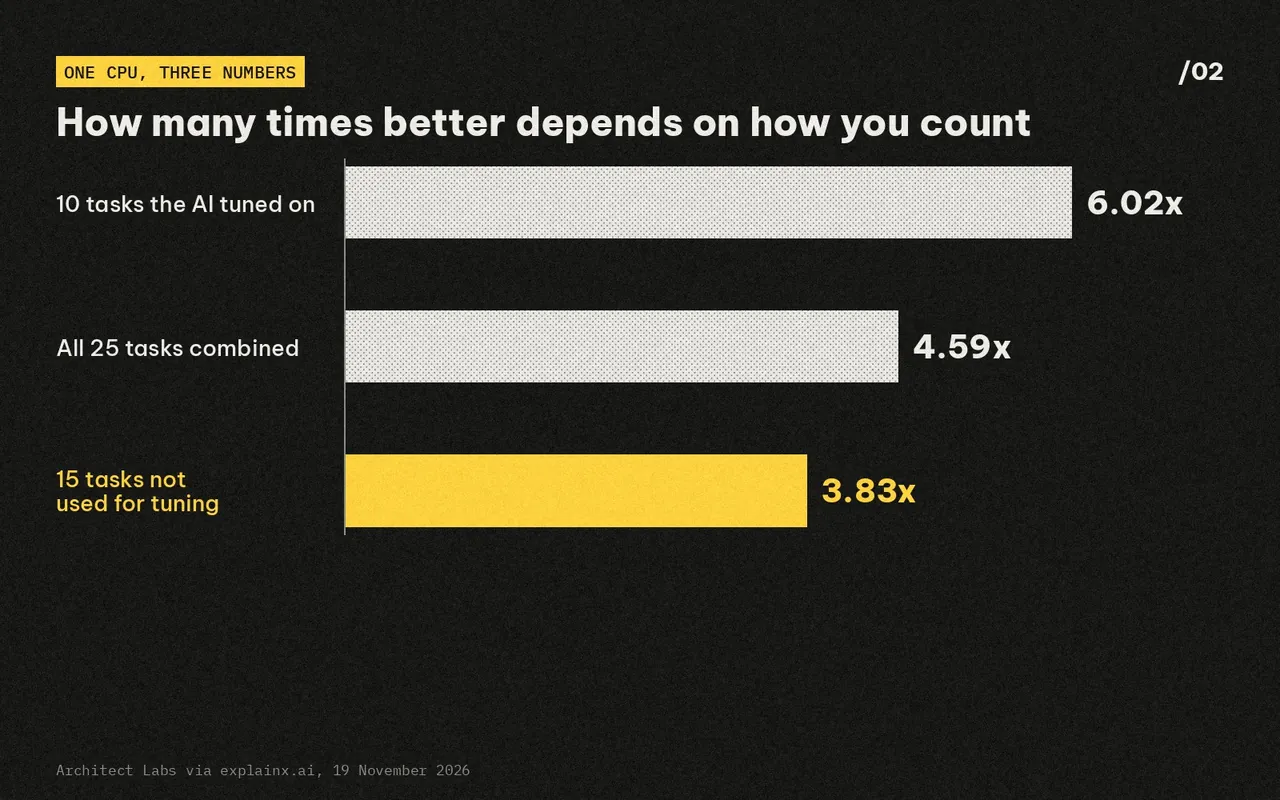
The number measures performance per watt: how much work gets done per unit of electricity, like how many hours of video you watch per percent of battery. Across the 25 tasks the company chose, a cluster of four Frostbite blocks reached 4.59 times the figure of one common CPU core of the type that executes instructions one after another.
But the 25 tasks are not all alike. According to the analysis site explainx.ai, 10 tasks were the set the AI used to tune the design and 15 were held back for the final evaluation. On the 10 tuning tasks the gain is 6.02x; on the 15 held-back tasks it is only 3.83x. The site calls 3.83x the better estimate of how the design generalises, because those tasks were not used to shape the chip.
More efficiency does not mean a faster chip or one that runs everyday software
VnExpress reports that the final results still show core CPU performance as "nearly stalled", and gives no further explanation. My guess is that it means the speed of each core did not improve, so 4.59x describes more work per unit of electricity, not a machine that runs 4.59 times faster.
There is another gap. Explainx.ai writes that the design is strongest on work that splits into parallel pieces, and that how well it holds up on everyday software such as databases, browsers or compilers is not shown. The Architect Labs team predicts AI will fundamentally change the architecture of many kinds of chips, from server processors to AI accelerators, but that is their prediction, not a verified result.
When you see "X times better", ask three questions before changing your plans
For someone choosing a laptop, Frostbite changes nothing today, because there is no chip to buy. When you meet a number like "4.59 times better", ask three things: was it measured on a real chip or in simulation, against what, and on how many tests the design was never tuned for. Frostbite answers the third, since the company reports 3.83x separately. The first two are still open: the chip has not been made, and the comparison CPU has no name.
So the open question is the real chip. Only when Architect Labs manufactures Frostbite, or a third party measures it, will we know whether 3.83x holds up outside simulation.
Sources
- VnExpress, "Tác nhân AI thiết kế kiến trúc CPU từ con số 0" (AI agents design a CPU architecture from scratch), 26 November 2026: https://vnexpress.net/tac-nhan-ai-thiet-ke-kien-truc-cpu-tu-con-so-0-5148262.html
- explainx.ai, "Frostbite: An AI-Designed CPU Claims 4.59x Performance per Watt. What Is Verified?", 19 November 2026: https://explainx.ai/blog/architect-labs-frostbite-ai-designed-cpu-interaction-nets-4-59x-perf-per-watt-claimed-vs-verified-2026
Sources
 Safety & policy · Nov 26, 2026AI Crypto-Breaking Rumor: Aaronson Never Said Bitcoin Was Broken
Scott Aaronson only said AI labs may hold a cryptography breakthrough; posts on X added Bitcoin. Three layers of the rumor, and…
 Safety & policy · Nov 26, 2026DeepSeek Says It Could Fall 9 Months Behind US AI Without Distillation
DeepSeek's own estimate puts its gap to US AI at 9 months if distillation ends. How solid is that number, and what…
 AI images · Nov 26, 2026New York Times bars new Photoshop over hidden AI labels
The New York Times told freelance photographers to stop using the latest Photoshop because AI can switch on unnoticed. Here is what…