Blog · AI Agent News · Safety & policy VIEN
Gmail Drops Custom-Domain Send As in 2027, Options From $0.99
Gmail ends third-party Send as in January 2027, pushing small site owners toward $0.99/month iCloud+, Migadu, or Cloudflare SMTP with safe DMARC settings.

In this article
On a Monday morning, a small shop owner opens a free Gmail inbox to reply to a customer message sent to their store's custom domain. Until now, clicking reply sent the response right back from that branded address without paying for a mailbox host. Starting in January 2027, however, that free setup stops working, stripping custom-domain identities from Gmail's sender menu and forcing replies onto a personal @gmail.com address.
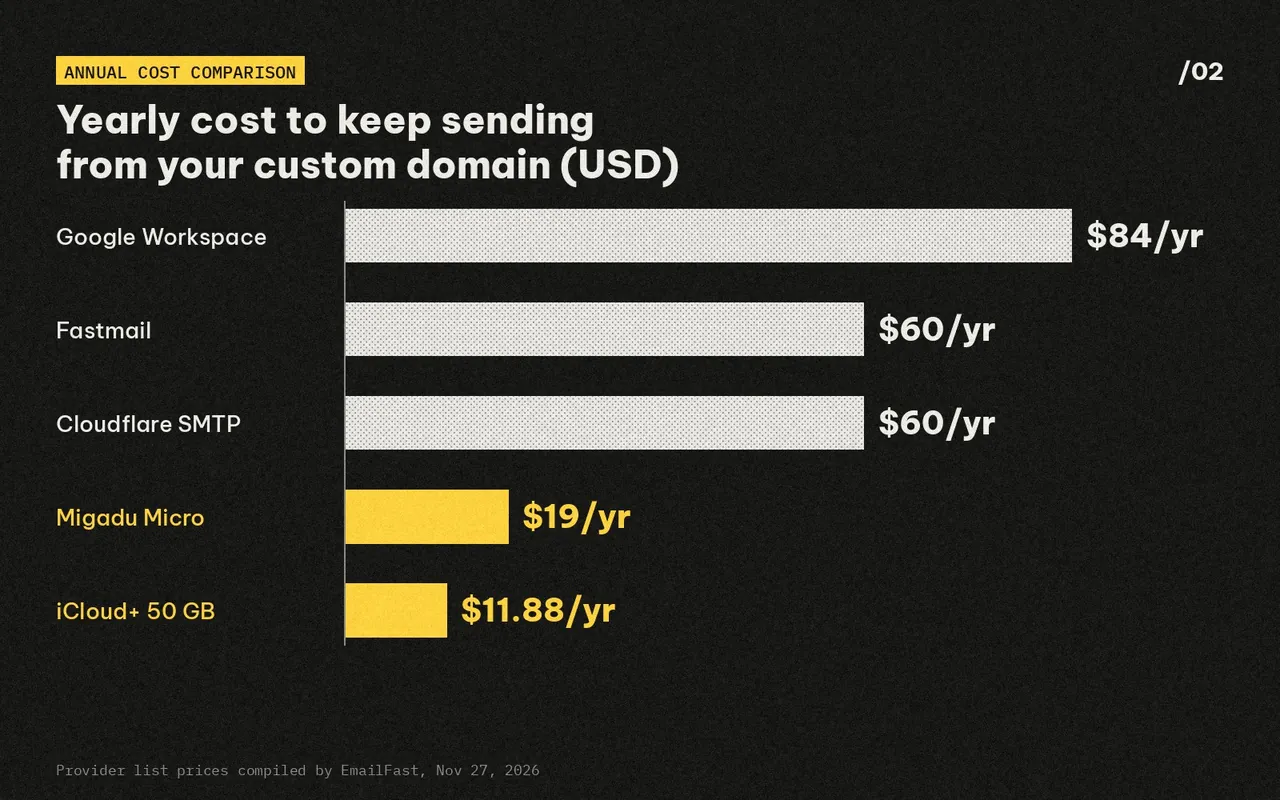
According to Google's official help documentation, Gmail will remove the Send as feature (which lets you borrow Gmail's interface to stamp an external domain onto outgoing mail, much like writing a letter at home with your shop's return address on the envelope) for all non-Google accounts across both the web and mobile apps. Instead of immediately upgrading to Google Workspace at $7 a month ($84 a year) just to keep one reply address, small site owners can switch to iCloud+ from $0.99 a month or Migadu Micro at $19 a year, while anyone picking Cloudflare's $5-a-month SMTP route must lower their DMARC record to monitoring mode during the switch so older Gmail replies do not bounce.
Inbound forwarding survives, but custom-domain replies break
During a transition period spanning Q3–Q4 2026 ahead of full removal in January 2027, Google is retiring three features tied to external mailboxes: third-party Send as, Gmailify, and POP mail fetching on the web. Once the cutoff hits, users can no longer link an unhosted domain address inside a free Gmail account to send replies directly. Even so, Google confirms that previously imported emails remain safe in your mailbox and that auto-forwarding from external providers into Gmail will continue to work.
For people using Cloudflare Email Routing, the catch is that Cloudflare only forwards incoming mail and does not host an actual mailbox. As detailed in EmailFast's November 27, 2026 breakdown, Google classifies any Cloudflare-forwarded domain as a third-party address even if your Send as entry connects through smtp.gmail.com with an app password. Although the Gmail mobile app still allows adding non-Google accounts, Cloudflare Email Routing has no mailbox server for the app to log in to.
flowchart LR
  A[Customer emails custom domain]:::data --> B[Cloudflare forwards to Gmail]
  B --> C[Incoming mail stays readable]:::key
  C --> D[Custom-domain Send as blocked]:::muted
  classDef key fill:#1d1a10,stroke:#ffd23f,color:#ffd23f,stroke-width:1.6px
  classDef human fill:#181817,stroke:#e8e6df,color:#e8e6df,stroke-dasharray:5 3
  classDef data fill:#1c1c1b,stroke:#8d8b85,color:#cfcdc6
  classDef muted fill:#181817,stroke:#3d3d3a,color:#8d8b85
Three low-cost alternatives to $84/year Google Workspace
Rather than paying $7 a month ($84 a year) for Google Workspace or $60 a year for Fastmail, solo web builders have three lower-cost paths depending on how many domains they manage and which apps they prefer. If you already use Apple hardware with two-factor authentication enabled, a 50 GB iCloud+ plan at $0.99 a month ($11.88 a year) includes Custom Email Domain support for up to 5 domains and 10 addresses per domain. Alternatively, Migadu Micro costs $19 a year with virtually unlimited domains, though it caps the entire account at 200 incoming and 20 outgoing messages per day.
The third option is keeping free unlimited inbound forwarding on Cloudflare Email Routing and paying $5 a month ($60 a year) for Cloudflare's Workers Paid plan to unlock outbound SMTP (the dedicated outgoing mail relay that dispatches messages under your domain independently of your inbox). That plan includes 3,000 outbound emails per month across your Cloudflare account plus $0.35 per 1,000 additional messages, connecting via smtp.mx.cloudflare.net on port 465 with implicit TLS inside desktop apps like Apple Mail or Thunderbird. Keep in mind that moving directly to iCloud+ or Migadu requires pointing your domain's mail records away from Cloudflare, which stops Cloudflare forwarding for that domain.
| Option | Listed pricing | Best fit |
|---|---|---|
| iCloud+ 50 GB | $0.99/mo ($11.88/yr) | Apple users, up to 5 domains |
| Migadu Micro | $19/yr (20 sent/day cap) | Multi-domain owners, light volume |
| Cloudflare SMTP | $5/mo (3,000 sent/mo) | Keeping Cloudflare inbound routing |
 Also readDario Amodei denies wanting AI to rule, 9.9 million views
Four steps to migrate before January and avoid the DMARC trap
Because Google warns it may restrict new third-party configurations during the Q3–Q4 2026 transition window, small domain owners should migrate early by following four orderly steps.
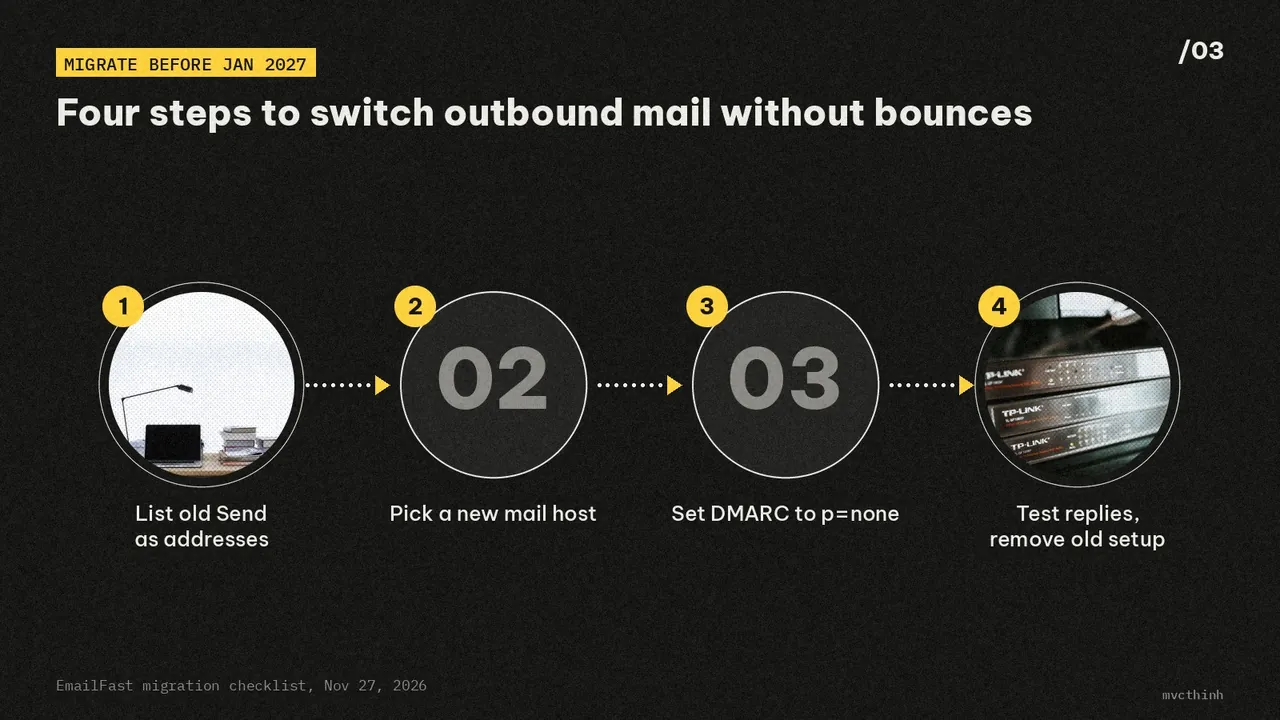
- Audit every legacy address: Open Gmail's Accounts and Import settings to list every configured
Send asentry, and cross-check your Cloudflare routing rules including any catch-all addresses. - Set up the new sending host: If you move to
iCloud+orMigadu Micro, update your domain mail records and send from their apps or desktop clients; if you choose Cloudflare Email Sending, generate an API token withEmail Sending: Editpermission and addsmtp.mx.cloudflare.neton port465with usernameapi_tokenin Thunderbird or Apple Mail. - Lower your domain authentication policy first: Before testing real replies on the new relay, check your
DMARCrecord (the domain rulebook telling recipient mail servers which senders are authorized and what to do with unverified mail) and temporarily set it to monitoring modep=nonewhile Gmail still sends. - Verify delivery before deleting old entries: Send test replies to Gmail, Outlook, and iCloud addresses to confirm domain checks pass cleanly, then remove the old
Send asentries in Gmail and tighten DMARC back up.
Instead of waiting until January 2027 to discover that customer replies have fallen back to a personal @gmail.com address—or overpaying $84 a year for Google Workspace—the shop owner from the opening scene only needs fifteen minutes today to audit old aliases. Picking an affordable host like iCloud+ or Migadu and keeping DMARC at p=none throughout the cutover ensures custom-domain replies stay uninterrupted without unexpected bounces.
Sources
 Agent basics · Nov 29, 2026Landlord AI okayed late rent, tenant still evicted 11 days early
An unlabeled apartment AI told Laura Mack on Nov. 8 she could pay $3,934.17 in back rent by Nov. 30, yet she…
 Coding agents · Nov 29, 2026OpenCode Hits iPhone Free, Needs Your Home PC On via QR
OpenCode's free iPhone app hit the App Store on Nov 28, 2026 to steer home coding sessions via QR code, keeping code…
 Automation · Nov 28, 2026Windows 11 frees nearly 900 MB RAM, speeds up Office 21% on 8 GB
Microsoft freed nearly 900 MB of background RAM in Windows 11 26H2, helping 8 GB office laptops run Office faster without buying…