Blog · AI Agent News · Agent basics VIEN
AI memory crunch pushes budget phone costs up, cuts models
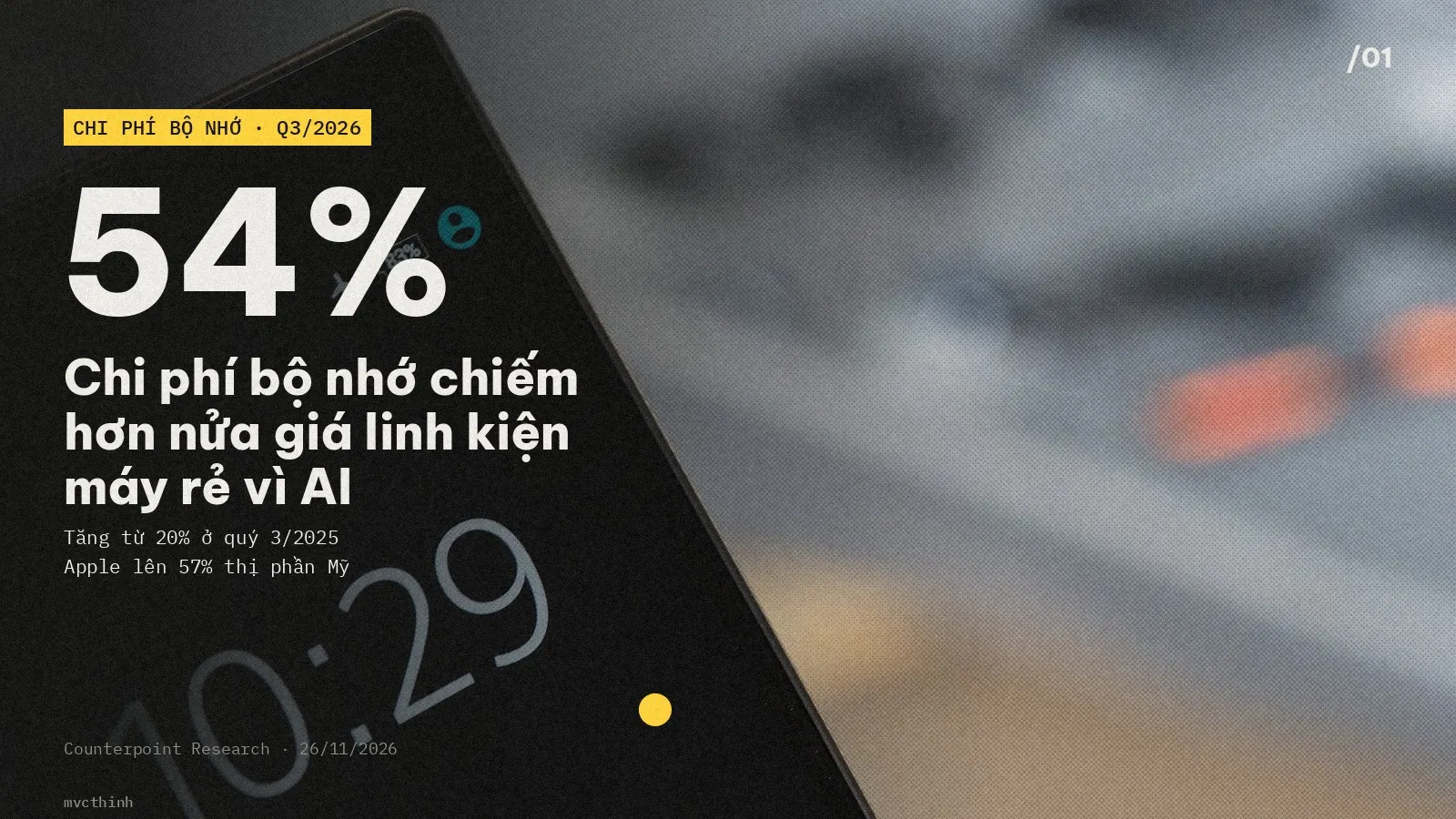
Memory now makes up 54% of a budget phone's component cost as fabs prioritize AI servers, leaving mainstream buyers facing higher prices ahead.
In this article
Budget smartphone shoppers in the US got a surprise in early April 2026 when a mainstream model jumped from 200 to 300 USD in one quiet adjustment, a 50% price hike with no major hardware redesign behind it. The culprit sat far outside the phone itself: semiconductor factories have been shifting production toward memory chips for AI data centers, pushing memory to 54% of total component costs in a low-end smartphone in Q3 2026, up from 20% in Q3 2025, according to Counterpoint Research figures released on November 26, 2026.
That component squeeze is already reshaping what everyday buyers get for their money in mainstream segments, where both supply and sticker prices are tightening. If you plan to replace a mid-range phone over the next few months, picking up remaining 2025 or early-2026 stock at current prices is safer than waiting for next-generation launches that risk higher tags.
Memory now eats 54% of a budget phone's component cost
Massive buildouts of AI data centers—giant server warehouses running AI models around the clock—are draining manufacturing capacity away from everyday phone memory. Memory, or RAM, acts like a phone's workbench: the bigger it is, the more apps a phone can juggle smoothly at once. As chipmakers move factory capacity from older phone memory standards to newer, more profitable server chips, affordable handsets get squeezed first.
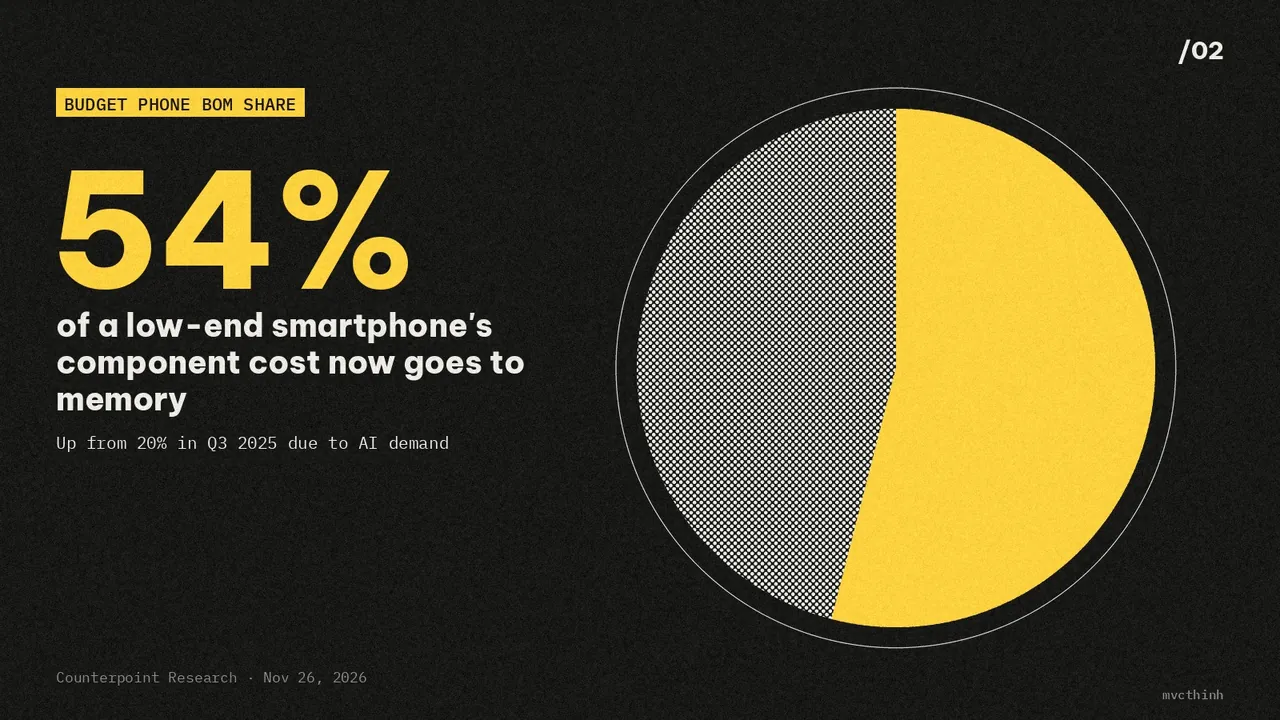
On a flagship phone priced above a thousand dollars, a few dozen dollars in extra component cost can still fit inside a wide profit margin. On a budget handset, letting memory swallow 54% of total parts leaves manufacturers almost nowhere to absorb the hit.
flowchart LR
  A[AI data centers pull chip supply]:::data --> B[Fabs shift to server memory]
  B --> C[Budget phone RAM supply shrinks]
  C --> D[Higher prices or fewer models]:::key
  classDef key fill:#1d1a10,stroke:#ffd23f,color:#ffd23f,stroke-width:1.6px
  classDef human fill:#181817,stroke:#e8e6df,color:#e8e6df,stroke-dasharray:5 3
  classDef data fill:#1c1c1b,stroke:#8d8b85,color:#cfcdc6
  classDef muted fill:#181817,stroke:#3d3d3a,color:#8d8b85
In Counterpoint Research's November 26, 2026 US market report, senior analyst Emily Herbert noted that rising memory costs hit Android's budget tier hardest, leaving brands with almost no room to absorb higher part prices without raising retail tags or cutting production.
Apple climbs to 57% US share while Samsung and Motorola squeeze supply
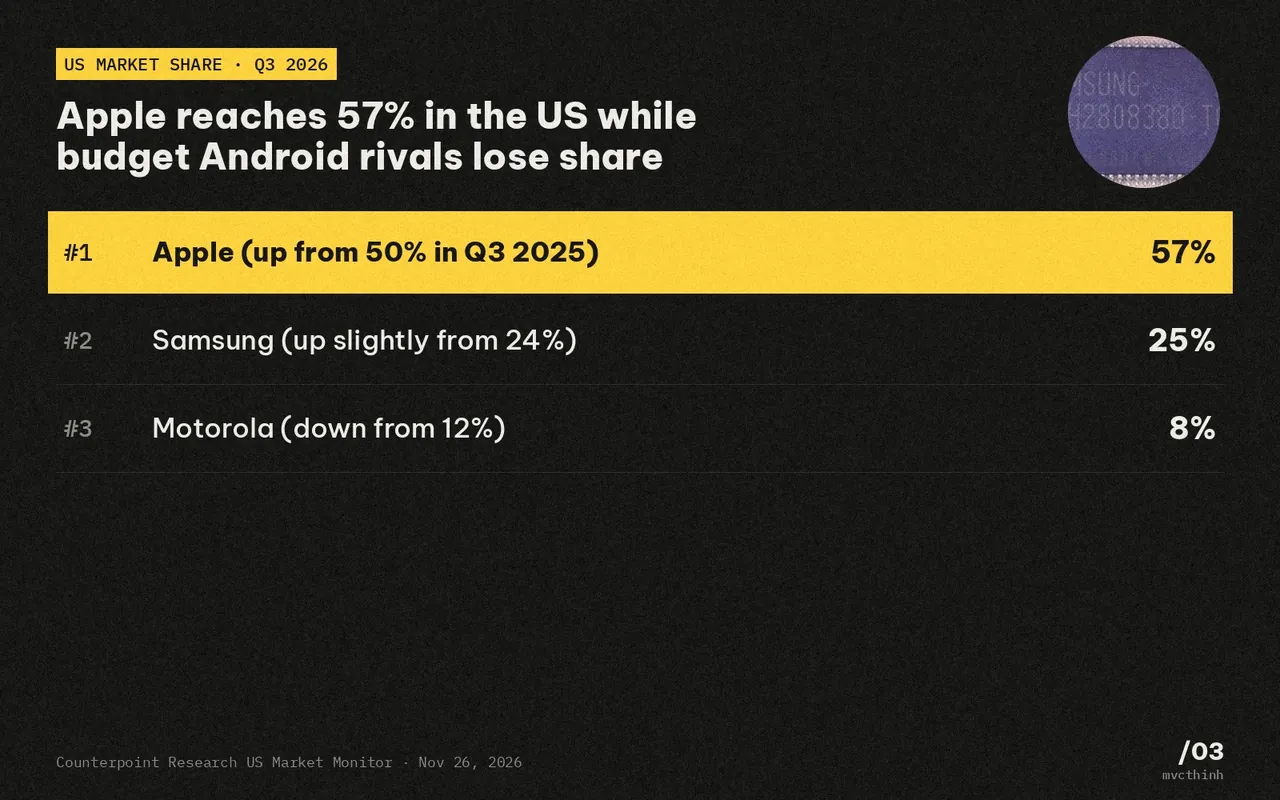
Less exposure to entry-level models helped Apple pull ahead even as overall US smartphone shipments dropped 9% in Q3 2026 compared with Q3 2025. Apple was the only major brand to avoid a US shipment decline, expanding its market share—the percentage of total phones shipped in a market—from 50% to 57%.
Android rivals felt the pinch in two distinct ways. Motorola, whose lineup leans heavily on affordable and mid-range phones, saw its US share drop from 12% to 8% after raising prices across several Moto G 2026 models by up to 50%, lifting the base Moto G from 200 to 300 USD in April 2026. Samsung managed to nudge its US share from 24% to 25% thanks to a broader mix spanning Galaxy S, Z, and A series, though its actual US unit shipments still declined below Q3 2025 levels alongside the shrinking market.
Worldwide, the pressure on mainstream Android options is set to deepen: Samsung is reportedly planning to cut Galaxy A production by around 10 million units a year starting in Q4 2026 and may raise prices on certain Galaxy A models by up to 19%. Because Galaxy A has historically generated more than 70% of Samsung's total smartphone shipments, shifting focus toward pricier Galaxy S and Z flagships narrows choices for cost-conscious shoppers.
| Brand | US market share in Q3 2026 | Pricing and supply move |
|---|---|---|
| Apple | 57% (up from 50%) | iPhone 18 Pro launched 100–500 USD higher; US three-week sales fell 4% |
| Samsung | 25% (up from 24%) | Plans to cut 10 million Galaxy A units a year; prices may rise up to 19% |
| Motorola | 8% (down from 12%) | Raised Moto G 2026 prices up to 50%, from 200 to 300 USD |
Still, leading in market share does not make Apple immune to component inflation. When the iPhone 18 Pro series launched 100 to 500 USD higher depending on storage, US sales during its first three weeks slipped 4% compared with the iPhone 17 Pro series, as shoppers felt the upgrades fell short of justifying the steeper tags.
 Also readGemini 4 Neon: Medium Costs 8× Less Than Claude, Scores Higher
My take
Near-term forecasts offer little relief for anyone waiting out a bargain on a new mid-range phone. Counterpoint Research senior analyst Maurice Klaehne warned that sticker price increases across both Android and iOS are set to stick around, while the firm estimates global smartphone shipments in 2026 will drop 15% from 2025 and does not expect memory prices to stabilize until mid-2027.
For everyday shoppers, waiting for the next product cycle carries real downside in 2026. Once memory eats 54% of a budget device's component bill, upcoming releases face an uncomfortable trade-off: either raise retail prices by 19% to 50% as Samsung is weighing and Motorola already did, or hold the sticker price by trimming base memory configurations.
If you need a reliable mid-range phone soon, compare current retail prices on 2025 and early-2026 models against their predecessors' launch prices and lock one in while inventory lasts. If your current handset still runs smoothly, holding onto it past mid-2027 gives component supply a chance to catch up. Either way, that quiet jump from 200 to 300 USD on a budget Moto G in April 2026 is an early sign that AI server demand is now repricing the phones in ordinary buyers' pockets.
Sources
 Agent basics · Nov 29, 2026Landlord AI okayed late rent, tenant still evicted 11 days early
An unlabeled apartment AI told Laura Mack on Nov. 8 she could pay $3,934.17 in back rent by Nov. 30, yet she…
 Agent basics · Nov 28, 2026TPU and Trainium beat Nvidia GPUs up to 2.5x on InferenceX
Google TPU and AWS Trainium beat Nvidia GPUs by 1.5 to 2.5x in performance per dollar on InferenceX, signaling lower AI subscription…
 Agent basics · Nov 23, 2026Delta Outage: Over 1,000 Flights Ran Late Even With Manual Backup
Delta switched to manual work, so flights stayed safe, yet nearly half still ran late. If you hand work to AI agents,…