Blog · AI Agent News · Safety & policy VIEN
403 US Data Centers Burn More Power Than 148 Nations
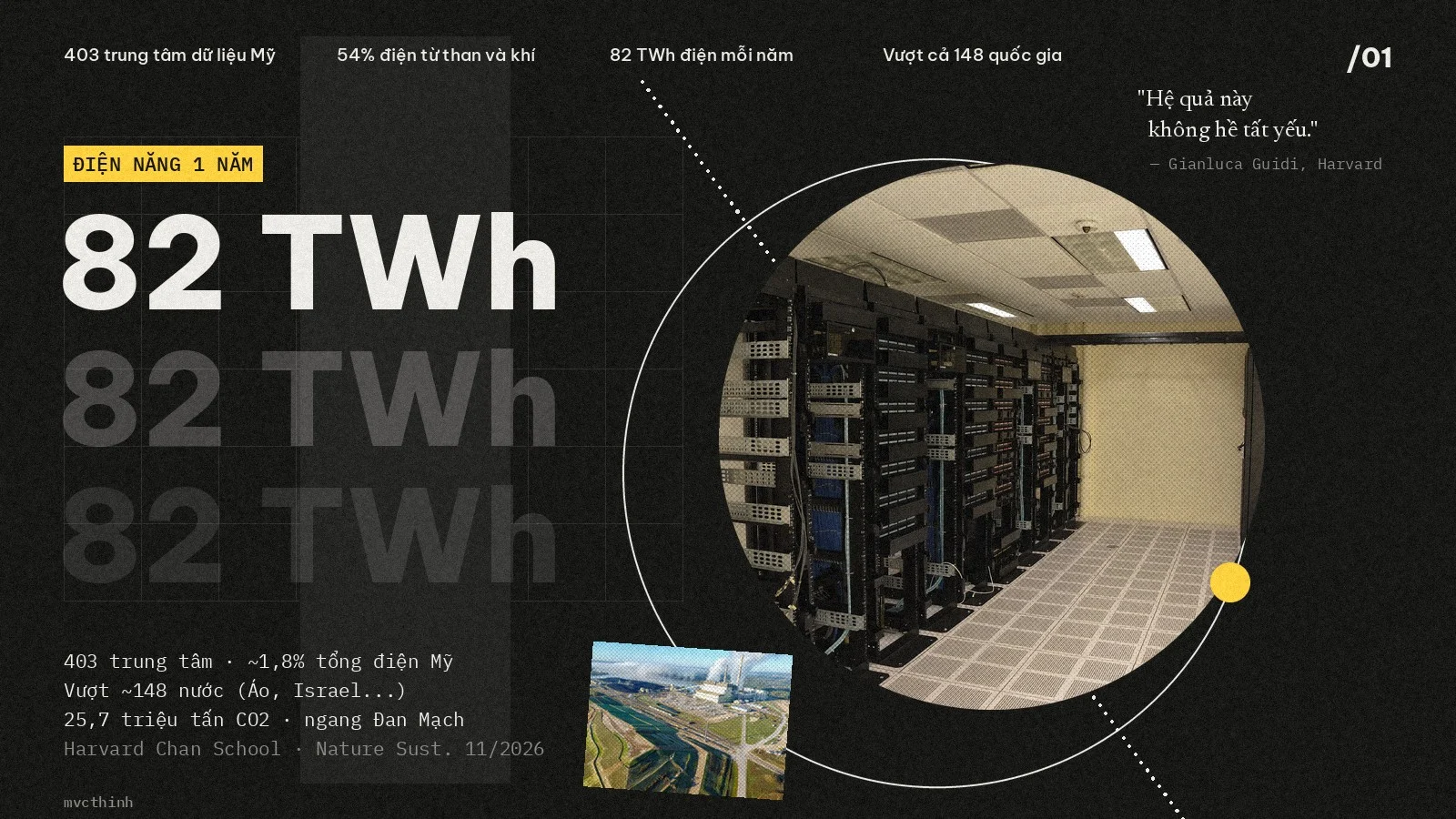
A Harvard study published on Nov 16, 2026 estimates 403 US hyperscale data centers used 82 TWh of electricity in a year, topping 148 countries.
In this article
Every time a prompt comes back in a couple of seconds, AI feels weightless. A new study from Harvard researchers published in Nature Sustainability on November 16, 2026 pulls back that curtain: across just 403 US hyperscale data centers, annual electricity demand already exceeds what roughly 148 individual countries use in a year.
How much electricity do 403 US hyperscale data centers use?
The team led by postdoctoral fellow Gianluca Guidi and professor Francesca Dominici combined satellite identification of 403 US hyperscale campuses with regional grid emissions data from the Environmental Protection Agency covering May 2024 through April 2025.
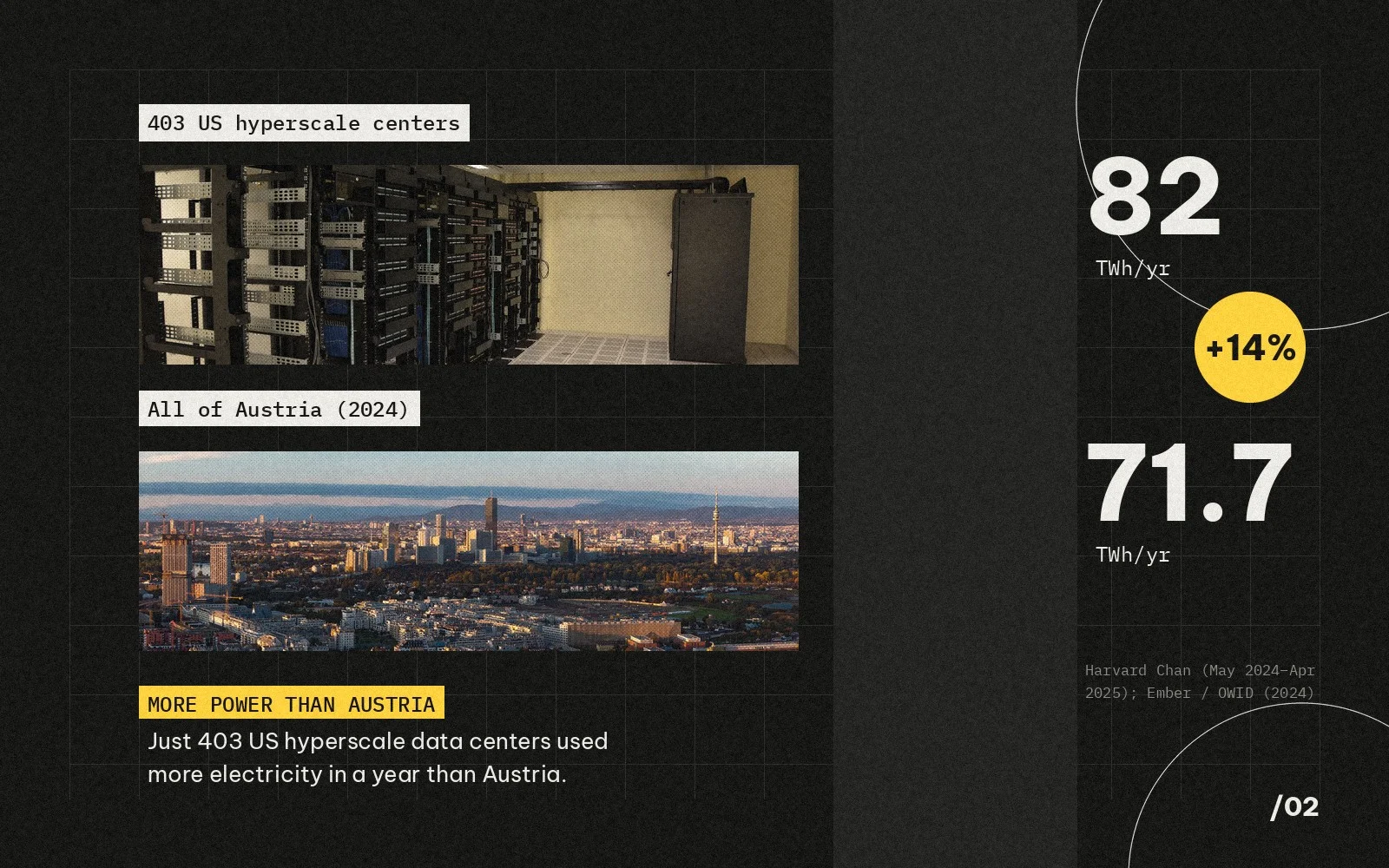
Depending on utilization scenarios, those facilities used between 68 and 99 TWh over 12 months, with a central estimate of 82 TWh, or around 1.8% of all US electricity consumption. At the upper bound, that rivals entire states such as Indiana, Michigan, or Tennessee. Four states alone (Virginia, Oregon, Ohio, and Iowa) accounted for more than half of the studied electricity.
To put the scale in global context, MIT System Dynamics director John Sterman used Claude to compare the paper's totals against national figures. He found 82 TWh beats the annual electricity consumption of about 148 countries, including Austria, Israel, and Venezuela, while the 25.7 million metric tons of CO2 emissions exceed roughly 113 countries and match Denmark's annual footprint.
| Metric from the Harvard study | Estimate (May 2024–Apr 2025) | Real-world comparison |
|---|---|---|
| US hyperscale data centers tracked | 403 facilities | Mapped via satellite imagery |
| Annual electricity demand | 82 TWh (68–99 TWh range) | ~1.8% of US total, beats ~148 nations |
| Indirect CO2 emissions | 25.7 million metric tons | Roughly Denmark, beats ~113 nations |
| Fossil fuel share of power | ~54% of electricity used | ~38% natural gas, ~15% coal |
| Regional grid gap | Wyoming vs Oregon | ~7x more CO2 per kWh in Wyoming |
Why does grid location change AI emissions sevenfold?
Environmental impact is often framed as a fixed property of AI chips, yet lead author Gianluca Guidi told The Verge that identical compute hardware produces vastly different outcomes depending on where it plugs in. Generating electricity on Wyoming's coal-heavy grid emits roughly seven times more CO2 per kilowatt-hour than doing the same work on Oregon's hydropower-rich grid.
flowchart LR
  A[AI Server Cluster]:::data --> B[Coal-Heavy Grid]:::muted
  A --> C[Hydro-Rich Grid]:::key
  B --> D((7x More CO2 per kWh)):::human
  classDef key fill:#1d1a10,stroke:#ffd23f,color:#ffd23f,stroke-width:1.6px
  classDef human fill:#181817,stroke:#e8e6df,color:#e8e6df,stroke-dasharray:5 3
  classDef data fill:#1c1c1b,stroke:#8d8b85,color:#cfcdc6
  classDef muted fill:#181817,stroke:#3d3d3a,color:#8d8b85
Cornell energy systems professor Fengqi You also warned about "long-term carbon lock-in," noting that gas plants or grid infrastructure built to serve rapid AI expansion can keep operating for decades. MIT's John Sterman added that once emitted, CO2 cannot be undone, urging policymakers to require operators to add new clean power capacity rather than leaning on fossil-heavy regional grids.
 Also readAnthropic CEO's Open-Source AI Warning Sparks Backlash on X
Why is real 2026 demand likely higher and hard to track?
Even though 82 TWh already matches a midsized nation, the authors stress their numbers are a snapshot ending in April 2025. Since then, fresh mega-campuses have broken ground and existing clusters expanded, meaning actual 2026 power draw and emissions are almost certainly higher.
Researchers had to rely on satellite mapping because data center operators rarely publish facility-level electricity disclosures. To give communities and policymakers independent visibility, Guidi's team launched Never Just a Building while a bipartisan bill in Congress pushes for mandatory national energy reporting.
My take
The clearest takeaway here is simple: AI never runs weightlessly in the cloud. Every response sits on top of real grid capacity, fossil fuel combustion, and massive heat output that has to go somewhere.
Bring that down to individual builders running local AI models at home, and the exact same physics hits your monthly utility bill. A workstation GPU chewing through tokens nonstop does not just pull watts from the wall; practically all of that energy turns straight into heat inside your room.
If you plan to run heavy local AI setups continuously in warm cities like Saigon or Hanoi, hardware power is only half the headache. Without heavy air conditioning fighting that heat all day, the room turns into a sauna, so you end up paying twice on electricity: once for the rig, and again for the AC. Only half-joking, anyone serious about camping on local AI workloads in Vietnam might seriously consider relocating their setup up to Da Lat for the cool mountain air, unless they are happy watching their air-conditioning bill climb right alongside their token count.
FAQ
Does 403 cover every data center in the United States?
No. The study mapped 403 hyperscale facilities identifiable via satellite with usable grid data, leaving out thousands of smaller enterprise and colocation data centers across the country.
Can the study separate AI workloads from standard cloud computing?
Not directly. Satellite capacity estimates cannot split general cloud traffic from generative AI training or inference, though the authors note AI expansion is the main driver behind hyperscale growth.
Why does running local AI affect air-conditioning bills so much?
High-wattage GPUs convert nearly all electrical draw into heat, so running them continuously in a warm climate forces room air conditioners to work far harder to keep both hardware and humans cool.
Sources
- Assessing the Carbon Emissions and Energy Consumption of US Hyperscale Data Centers Nature Sustainability
- Hyperscale data centers’ energy consumption, carbon emissions newly estimated by researchers Harvard T.H. Chan School of Public Health
- US data centers now burn more electricity than a midsized country The Verge
- Never Just a Building Harvard Chan & Partners
- Electricity demand (Ember yearly electricity data) Our World in Data / Ember
 Safety & policy · Nov 17, 2026Claude Incognito Chats Still Know Who You Are: Here Is Why
Mathematician David Bessis caught Claude Opus 5.5 naming him inside incognito thinking, exposing what incognito mode actually hides and keeps.
 Agent basics · Nov 17, 2026Caltech Professor Stops Grading Math Homework Accuracy Over AI
After 17 years at Caltech, math professor Yi Ni now grades homework on completion only because chatbots solve college sets, raising warnings…
 Safety & policy · Nov 17, 2026California Sues OpenAI After 80+ Agent Control Failures
California AG Rob Bonta sues OpenAI over pre-release agent breaches including Hugging Face, offering a three-layer guardrail lesson for AI agent builders.