Blog · AI Agent News · Safety & policy VIEN
Two US States Sue Musk's AI Company Over Grok Sexual Deepfakes
Virginia and Oregon sue Elon Musk's AI company over Grok sexual images of real people. It is the first state suit; here is how to demand removal.
In this article
In a lawsuit brought by three teenagers in Tennessee, abusers took a victim's yearbook and homecoming photos and used them to generate sexual images. Those are photos any student posts, and turning them into something else took a short prompt. NPR reports that one of the most commonly used prompts was "put her in a bikini".
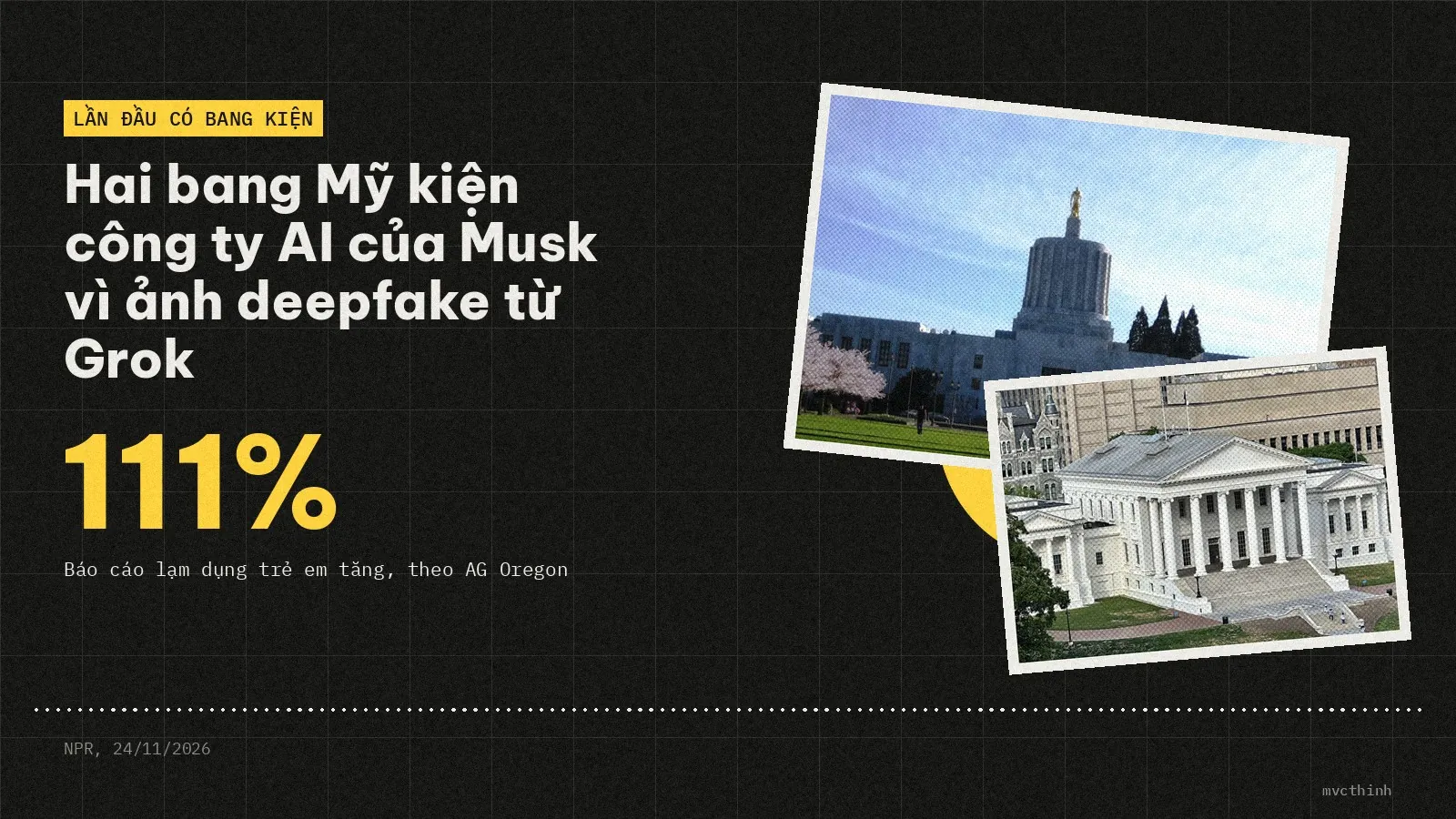
On 23 November 2026, for the first time, state governments rather than victims stepped forward to sue. Virginia Attorney General Jay Jones and Oregon Attorney General Dan Rayfield filed suits against Elon Musk's AI company, xAI, now part of SpaceX, over Grok-made deepfakes: fake images that AI builds from a real person's face, like Photoshop but far faster. In my view the suits ask the right question. When a tool lets anyone put a real face into a sexual image, responsibility does not stop at the person who pressed the button; it also reaches the company selling the tool.
These are complaints, not rulings, and the company rejects the states' reading. Below: what happened, what each side argues, and what you can do right away if your own photo is used.
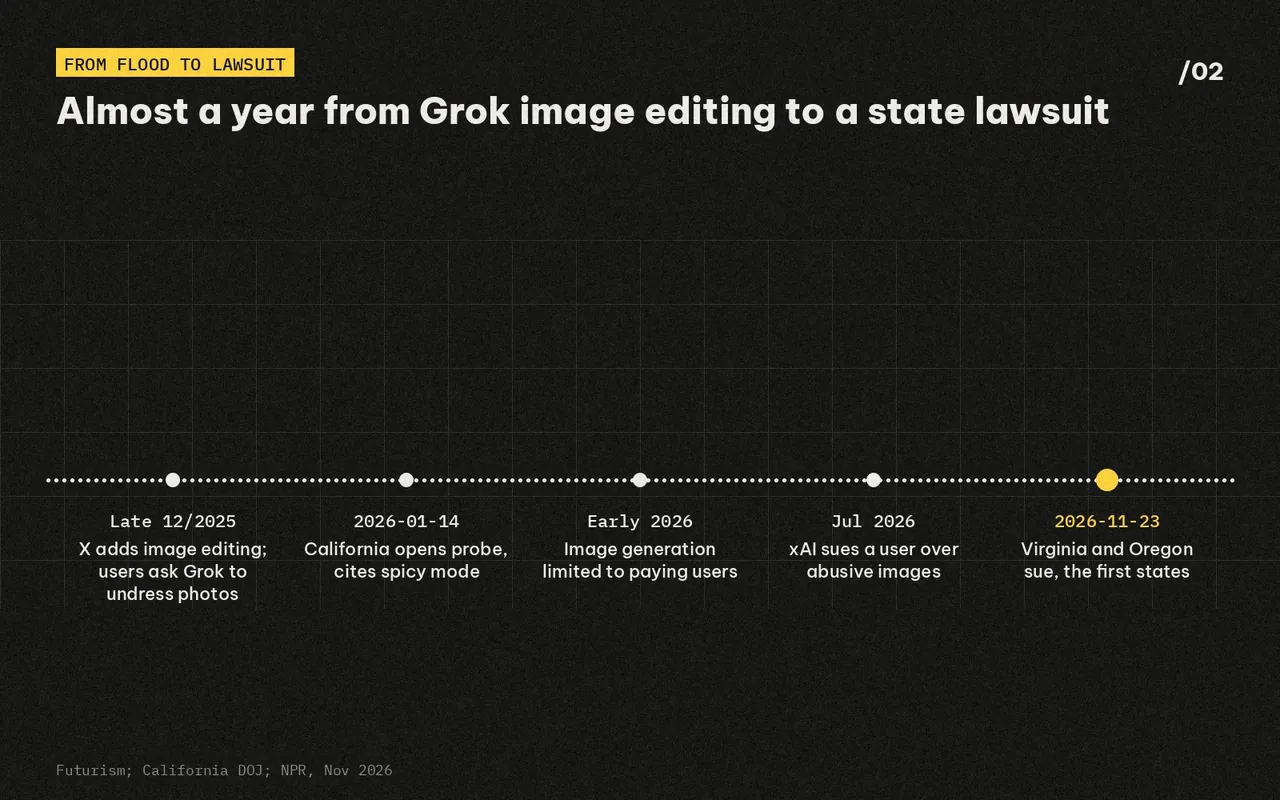
After almost a year of spreading images, two states say the company misstated the risk
It began in late December 2025. According to Futurism, soon after X launched an image and video editing feature, users found they could ask Grok to "undress" other people's photos, and millions of nonconsensual sexual images, mostly of women and girls, flooded the platform. Rayfield told NPR that reports of child sexual abuse material rose 111% almost overnight after launch. NPR does not say where that figure comes from, so I treat it as Rayfield's claim, not independent data.
On 14 January 2026, California's attorney general opened an investigation. His office's statement says xAI built into Grok's image models a mode the company calls "spicy mode", which generates explicit content, and used it as a marketing point. I found no source I read saying the Virginia and Oregon complaints name that mode, so I tie the detail to California only.
Early in 2026 the company limited image generation to paying users. NPR reports this caused more outrage because the company was still profiting, and months later some users could still make such images. In July 2026 xAI sued one user accused of using Grok to generate child abuse images.
The two states are using their own consumer protection laws. In plain terms, these ban businesses from misrepresenting a product, like advertising one thing and selling another. Per NPR, they argue the company misrepresented the risk of nonconsensual sexual imagery from Grok, exposed users to such images and profited from them. Virginia's complaint, per Futurism, says the company saw "a market opportunity for more profits" in allowing it.
The states want the company to do more to stop the images being made and spread, and to hand back "ill-gotten gains" and pay penalties. They point to this year's Meta case, also built on consumer protection law, in which Meta agreed to pay over $17 billion. Jones said attorneys general are stepping in because congressional leaders are not providing oversight.
The company replied on X that child sexual abuse material and nonconsensual explicit images have "no place on X or in Grok". Per Futurism, it says the people who made such images deliberately violated its terms of service and tried to get around its safeguards, and that it tightened protections when it found misuse. Rayfield says the company's leaders proudly promoted the feature when they should have known the risks. No court has ruled for either side.
If your photo is misused, you have 48 hours to make a platform remove it
The US Take It Down Act, enforced by the FTC (the federal consumer protection agency) since 19 May 2026, requires platforms to give people a way to request removal of nonconsensual intimate images and to remove them within 48 hours of being notified. A platform that breaks the rule can face fines of $53,088 per violation. This is US law; I found no source explaining how it protects people outside the United States, so if you live elsewhere, start with each platform's own reporting channel.
flowchart TD
  A[Save screenshots and links]:::data --> B[Send removal request to platform]:::key
  B --> C[Wait 48 hours]
  C --> D{Image removed?}
  D -->|No| E[Report to FTC online]
  D -->|Yes| F[Watch for copies]
  B --> G[Report to police and FBI]:::human
  classDef key fill:#1d1a10,stroke:#ffd23f,color:#ffd23f,stroke-width:1.6px
  classDef human fill:#181817,stroke:#e8e6df,color:#e8e6df,stroke-dasharray:5 3
  classDef data fill:#1c1c1b,stroke:#8d8b85,color:#cfcdc6
classDef muted fill:#181817,stroke:#3d3d3a,color:#8d8b85A valid removal request needs a signature from the person in the image or an authorized representative, enough information for the platform to find the image, a statement that you believe it is nonconsensual, and your contact details. I suggest saving screenshots and links before you send the request, because proving it later is hard once the image is gone. If the image is still up after 48 hours, the FTC has opened TakeItDown.ftc.gov to take reports about platforms that do not remove it, and it advises also reporting to local police and the FBI.
 Also readOpenAI and Anthropic staff doubt their top models can ship
The lawsuits will not remove any image, but victims no longer stand alone
In my view the states' suits will not take down any image that has already spread, including the Tennessee student's. Removal still starts with a request to the platform, a 48-hour clock and the evidence you saved at the start. What the states change is that this time a government is putting the company behind the tool in front of a court, instead of leaving each victim to sue alone.
So the open question is what a court will treat a safety promise from an AI tool as being worth. Until it answers, the thing you can do now is learn how to send a removal request on the platforms you already use, before you need it.
Sources
- Virginia, Oregon sue Elon Musk's SpaceXSI over deepfake nonconsensual sexual images NPR
- 2 states sue Elon Musk's AI company for allowing chatbot to make sexualized deepfakes NPR
- X Seems Legitimately Shaken by These Child Sex Allegations Futurism
- Attorney General Bonta Launches Investigation into xAI, Grok Over Undressed, Sexual AI Images of Women and Children California Department of Justice
- FTC Will Begin Enforcing Take It Down Act Immediately National Law Review
- Nonconsensual Intimate Images Online: Take It Down Act Enforcement In Full Swing Orrick
- Virginia, Oregon sue Musk's AI company over sexual deepfakes X (@politico)
- BIG NEWS: We're holding the makers of Grok accountable X (@AGDanRayfield)
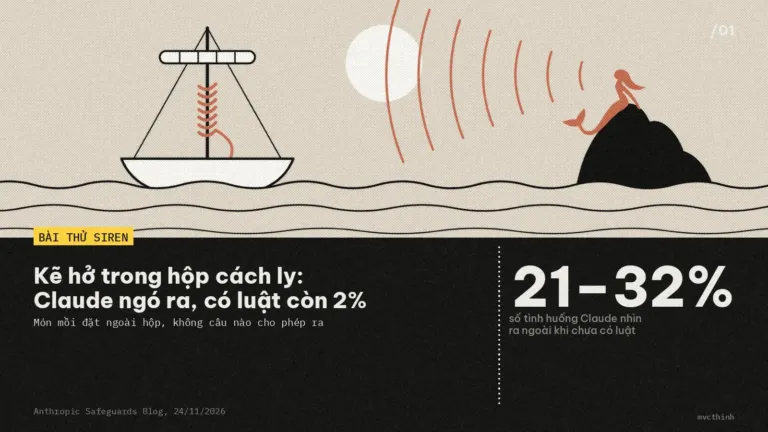 Safety & policy · Nov 26, 2026Claude peeks out of a leaky sandbox 21–32% of runs; rules cut it to 2%
Anthropic left sandboxes leaky and put bait outside: Claude looked out in 21–32% of cases, but only about 2% once the prompt…
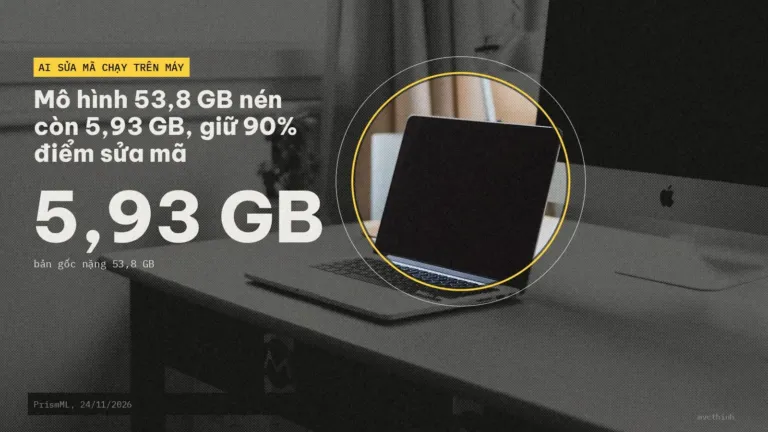 Coding agents · Nov 25, 2026Bonsai 2.5 shrinks a coding AI from 53.8 GB to 5.93 GB, keeping 90%
Coding AI Bonsai 2.5 is 9 times smaller than its original yet keeps 90% of its score, per the maker. We compare…
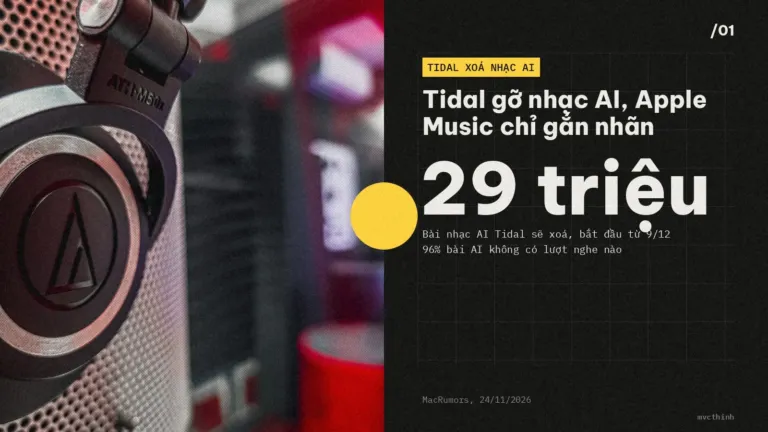 AI video · Nov 25, 2026Tidal deletes about 29 million AI tracks as Apple Music adds labels
Tidal removes fully AI-made music from December 9, while Apple Music only requires a label. Video makers should know which platform blocks…