Blog · AI Agent News · AI images VIEN
AI Animated Short Took 55 Runs, Showing Real Effort
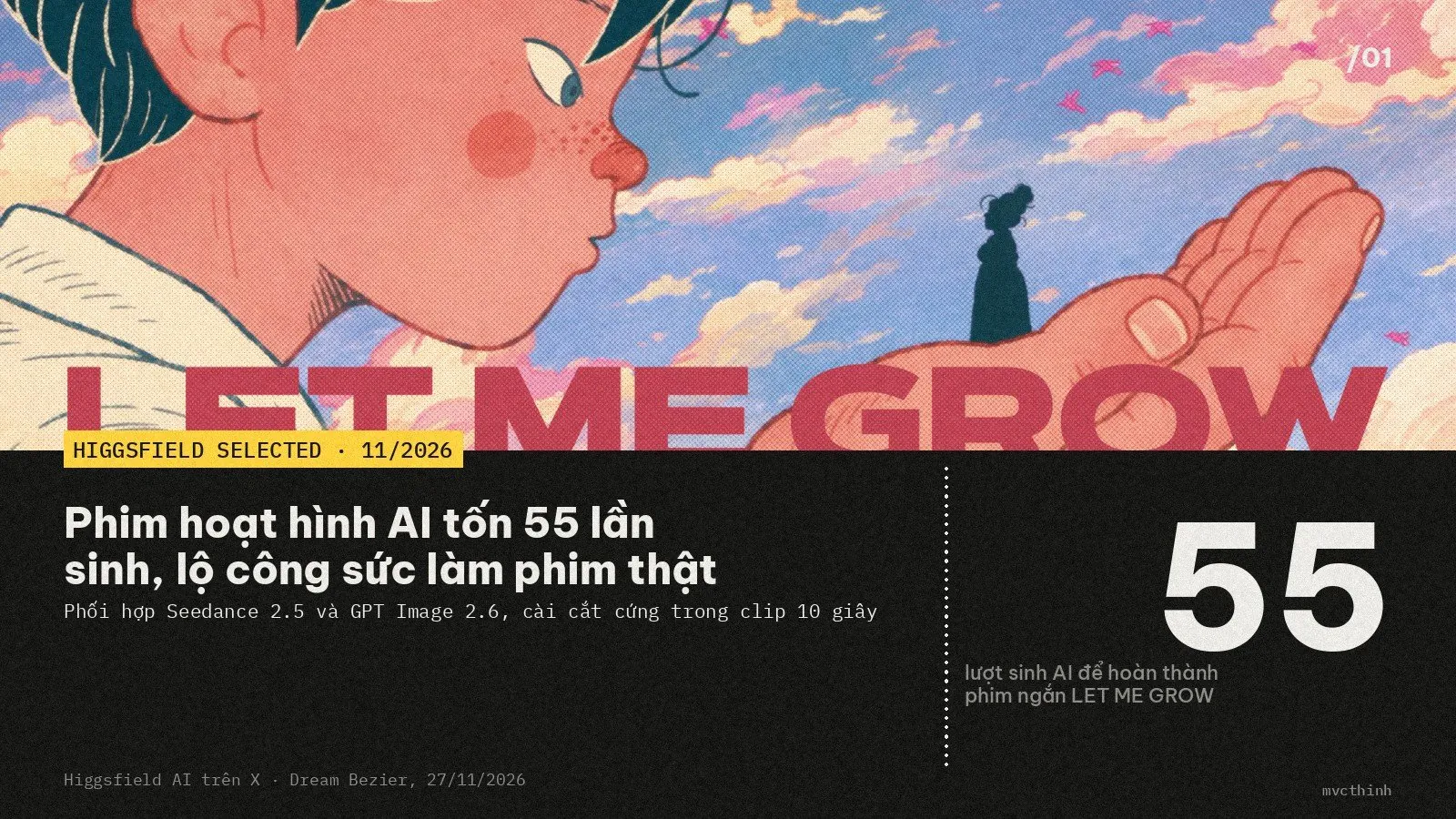
Dream Bezier's 2D short LET ME GROW reached Higgsfield Selected after 55 runs with Seedance 2.5 and GPT Image 2.6, showing why creators direct every shot.
In this article
Why 55 generations still demand careful budget planning
Requiring 55 generations for one short film means creators cannot click generate once and export; every tricky angle and motion beat goes through multiple iterations. For independent creators and small studios, each retry draws directly from a paid subscription allowance while adding hours of review to filter out broken frames.
According to Higgsfield's official pricing as of November 28, 2026, individual plans range from 19 USD per month for 270 credits on Starter, to 59 USD for 1,200 credits on Plus, and up to 375 USD per month on the 9,000-credit Ultra plan at standard monthly billing. When a short project requires 55 runs across setup and cleanup passes, lower-tier allowances leave almost no room for repeated failed clips.
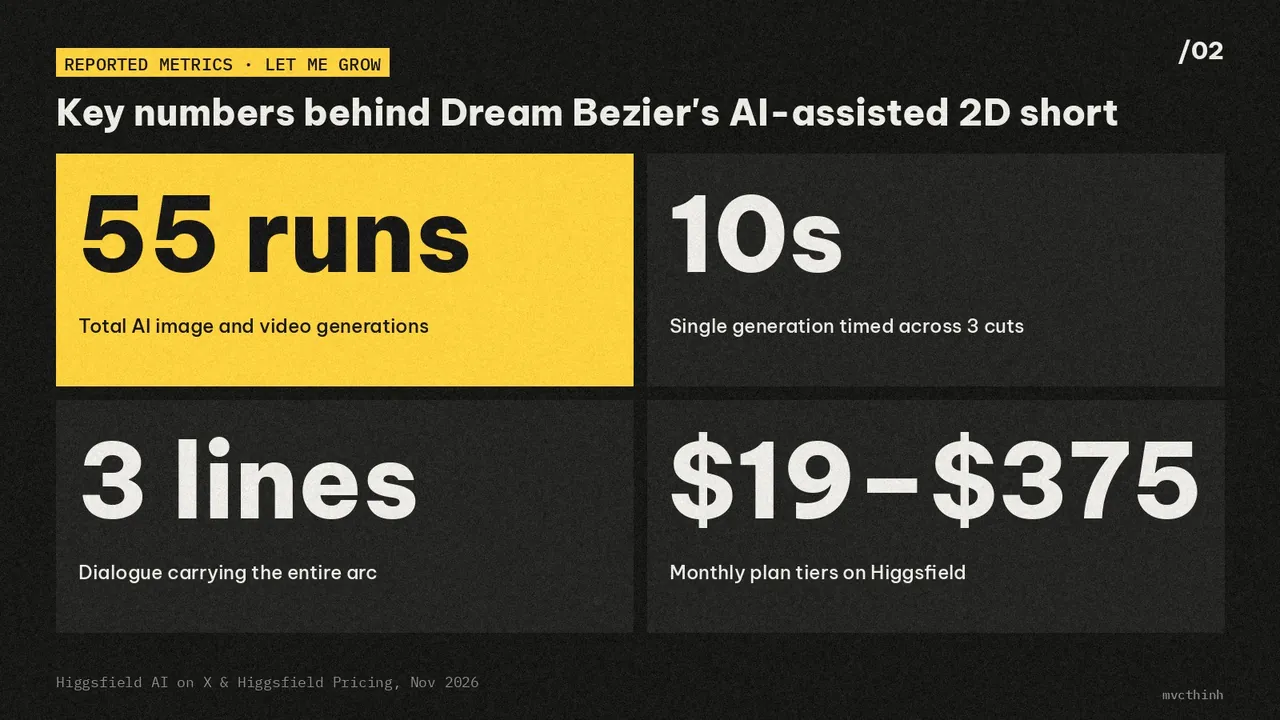
Still, not every step drains credits at the same rate. Higgsfield includes limited or short-term unlimited web access for select image models at low or medium quality, placing the heaviest budget pressure on Seedance 2.5 video runs and iterative refinements.
How Dream Bezier locked linework and timed cuts by hand
To stop the pipeline from collapsing into flat, templated outputs, Dream Bezier enforced four manual controls covering motion cadence, camera layout, cut timing, and isolated fixes.
First, instead of letting the video model interpolate ultra-smooth live-action motion, their brief forced traditional animation mechanics into the prompt: solid-drawing construction for 3D volume per angle, animation on twos—holding each drawing for two frames just like classic hand-drawn cartoons—and continuous line boil so pencil contours subtly shimmer even when a character stands still.
Second, on complex framing such as the catch shot, Dream Bezier used a GPT Image 2.6 still strictly as a spatial blueprint rather than visual wallpaper. Their Seedance 2.5 prompt instructed the model to read @Image1 as a camera diagram only—copying its low camera position, upward viewing angle, crop, and foreground-to-background layout without freezing the character into the static pose.
flowchart LR
  A[Lock 2D cadence]:::data --> B[Still as camera map]
  B --> C[Time 10s multi-cuts]
  C --> D[Isolated layer edits]:::key
  classDef key fill:#1d1a10,stroke:#ffd23f,color:#ffd23f,stroke-width:1.6px
  classDef human fill:#181817,stroke:#e8e6df,color:#e8e6df,stroke-dasharray:5 3
  classDef data fill:#1c1c1b,stroke:#8d8b85,color:#cfcdc6
  classDef muted fill:#181817,stroke:#3d3d3a,color:#8d8b85
Third, the team directed multi-shot pacing inside a single 10-second Seedance 2.5 generation. For the growth sequence, one prompt timed three shots with hard cuts at 2.5 seconds and 5.5 seconds, locking character proportions and line boil across all three angles instead of generating disconnected clips that drift apart during editing.
Fourth, when a clip nailed the motion but missed a background detail or shadow, they avoided re-rolling from scratch and ran isolated video-to-video passes—much like swapping only the background layer in a photo editor without touching the foreground subject. Each pass requested a single edit, such as swapping only the classroom background or adding only the teacher's cast shadow on the boy's face.
| Production stage | Typical one-prompt approach | Dream Bezier's manual control |
|---|---|---|
| 2D motion feel | Smooth auto-interpolation, flat look | 3D construction, animation on twos, line boil |
| Reference images | Let the model copy the still directly | Read still strictly as a camera diagram |
| Cuts and cleanup | Separate clips, full re-roll on errors | 3 hard cuts in 10s, single-change layer edits |
 Also readTidal deletes about 29 million AI tracks as Apple Music adds labels
My take
Even with enough craft to earn a Higgsfield Selected spot, Dream Bezier noted in the brief that LET ME GROW relies on just 3 lines of dialogue to carry its emotional arc. That leaves open how well this workflow holds up for dialogue-heavy films or strict lip-sync, and the X thread does not disclose how many human hours went into curating failed runs and assembling sound.
For solo creators or small animation teams testing AI 2D pipelines, the practical takeaway from these 55 runs is to separate framing setup from detail fixes early on. Using static images strictly as camera diagrams and running single-change edits preserves winning motion clips instead of wasting credits re-rolling entire shots, keeping final assembly cleaner alongside editing tools like toEdit.
LET ME GROW shows that an AI-assisted pipeline can preserve real hand-drawn character weight, while exposing the steady manual direction required behind the scenes. With 55 generations needed to lock every beat and cut, AI video works best as a fast in-between assistant while pacing and taste remain firmly human.
Sources
- Higgsfield AI on X: LET ME GROW by Dream Bezier breakdown X
- LET ME GROW | Higgsfield Community Higgsfield Community
- Pricing plans — Higgsfield AI Higgsfield
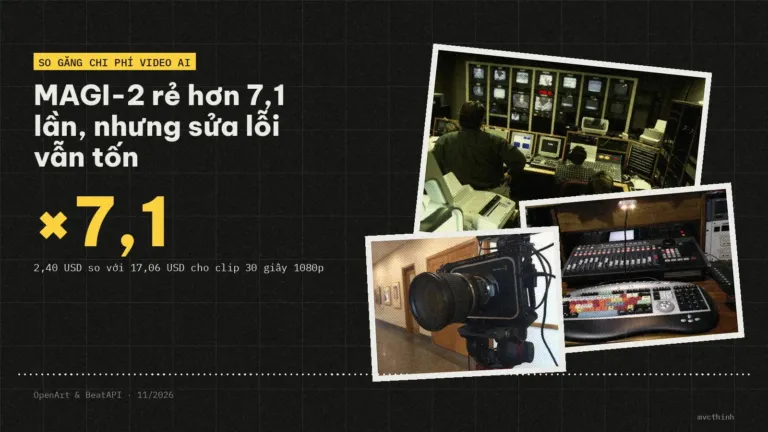 AI video · Nov 29, 2026MAGI-2 AI video cuts costs 7x, yet skips 480p draft mode
Sand.ai launched its MAGI-2 video API on Nov 24, 2026 at $0.08/s ($2.40 per 30s at 1080p), cutting raw costs while lacking…
 Coding agents · Nov 27, 2026Leaked clips said to be Opus 5.6: watch three of them on X
Clips tagged Opus 5.6 are spreading on X, but Anthropic has not announced the model. This post embeds three of them so…
 AI images · Nov 26, 2026New York Times bars new Photoshop over hidden AI labels
The New York Times told freelance photographers to stop using the latest Photoshop because AI can switch on unnoticed. Here is what…